

Building Safety Act Gateway 2 in 2026: Why 40% Fail and How to Pass First Time
Navigating the Gateway Process for Higher-Risk Buildings—From Criminal Liability to Completion Certificate
If you're developing high-rise residential buildings in 2026, Gateway 2 has probably become the most expensive bottleneck in your development programme. While you were focused on planning permission and land deals, the Building Safety Regulator introduced a "hard stop" that's been reported to add 12 to 18 months to project timelines in many cases, with industry surveys showing rejection rates for early applications running at around 40%, and leaving £millions in holding costs on completed buildings waiting for occupation approval.
The Building Safety Act 2022 fundamentally changed how higher-risk buildings get built in England. The three-gateway approval regime—covering planning, pre-construction, and occupation—was designed to prevent another Grenfell. What wasn't fully anticipated was the scale of delays, rejections, and commercial chaos the system would create for developers navigating it for the first time during 2024-2025.
Here's what parliamentary evidence and industry reporting revealed: as of mid-2024, only a very small proportion (around 2% according to government responses) of Gateway 2 applications were being determined within the statutory 12-week timeframe. Average determination times were reported at 22 weeks, with some developers experiencing waits of 40 weeks or more. Industry data suggested rejection rates of 40-50% for applications during the early rollout period.
But there's good news. By late 2025, BSR performance updates showed approval rates had climbed to around 73% as both the regulator and industry learned from early failures. Reforms introduced in 2025—including expanded Technical Specialist Teams, staged submission guidance, and approximately 100 additional staff—have improved turnaround times. The developers winning at Gateway 2 aren't the ones with the biggest budgets. They're the ones who understand why applications fail and design their approach accordingly.
This guide breaks down Gateway 2 from a developer's perspective: why the 40% failure rate exists, what the BSR actually needs to approve your scheme, how the 2025-2026 reforms change the game, and practical strategies to pass first time without the 18-month delay.

1. Understanding Higher-Risk Buildings and the Gateway Regime
Before diving into Gateway 2 specifics, let's clarify what triggers the Building Safety Act regime in the first place.
What Qualifies as a Higher-Risk Building (HRB)?
Your project needs Building Safety Regulator approval if it meets all three criteria:
Height: At least 18 metres tall OR at least 7 storeys
Use: Contains at least 2 residential units (this includes purpose-built student accommodation, build-to-rent, care homes with residential units)
Work type: New construction, work causing an existing building to become an HRB, or material change of use to HRB
The 18-metre threshold is measured from ground level to the finished floor level of the top storey. If your scheme hits 17.9 metres, you're in traditional Building Control. At 18 metres, you're in the Gateway regime with the BSR as your only Building Control option.
This matters commercially because the Gateway regime adds significant time and cost compared to traditional routes. Some developers are now designing schemes at 17 metres or 6 storeys specifically to avoid HRB classification—a trend the industry is calling "designing down."
The Three Gateways Explained
The Building Safety Act introduced three mandatory checkpoints. Think of them as safety gates you can't bypass:
Gateway 1 (Planning Stage): Submit a Fire Statement with your planning application demonstrating fire safety considerations are embedded in design. This has been in force since August 2021 under planning legislation.
Gateway 2 (Pre-Construction): Obtain Building Control Approval from the BSR before starting any construction work. This is the "hard stop" causing the current crisis. You cannot get on site without Gateway 2 approval. Period.
Gateway 3 (Pre-Occupation): Obtain a Completion Certificate from the BSR before anyone can legally occupy the building. Then register the building with the BSR before occupation or face criminal penalties.
Gateway 2 is where 90% of the pain is concentrated. That's where this guide focuses.
2. The Gateway 2 Crisis: By the Numbers
Let's talk about why Gateway 2 has become the development industry's biggest headache in 2026.
The Statutory Promise vs Industry Reality
The Building Regulations committed the BSR to determining Gateway 2 applications within:
12 weeks for new build applications
8 weeks for alterations to existing HRBs
That timeline assumed smooth sailing: complete applications, competent teams, clear compliance narratives. It proved wildly optimistic.
Here's what industry reporting and parliamentary evidence revealed when Gateway 2 launched in October 2023:
Early 2024 (First 9 Months):
According to parliamentary questions, by end of June 2024, only a very small proportion (reported as around 2%) of 668 applications were determined within statutory timeframes
Industry bodies reported that approximately 40% of applications submitted during this period were refused
Developer surveys and FOI requests suggested average determination times significantly exceeding the statutory targets, with many schemes experiencing 25+ week waits
February 2025 BSR Update:
The BSR confirmed Gateway 2 approvals were taking an average of 22 weeks
Multiple developers reported through industry channels that some applications had waited 40+ weeks
FOI data suggested 92 new build projects and 641 remediation projects were on hold pending Gateway 2 approval
By Late 2025 (Post-Reform):
BSR performance updates showed approval rates had climbed materially, with regulator reports indicating approximately 73% approval rates
The BSR reported 272 building control decisions made by November 2025
Technical Specialist Teams were reported to be meeting or approaching the 12-week SLA for cases they handled
152 new build applications covering approximately 33,670 units were actively being processed
The improvement is genuine, but even the "improved" system adds 6-12 months to programmes compared to pre-2023 Building Control for most applications.
Why Early Rejection Rates Were So High
The BSR has been candid through its performance updates and parliamentary evidence about what went wrong:
70% of rejected applications were reported by the regulator as failing because they didn't contain adequate information or couldn't demonstrate Building Regulations compliance.
40%+ of applications were flagged as being invalidated at initial validation stage due to missing or inadequate information.
Around 20% of applications were rejected for being completely invalid—applicants couldn't demonstrate that the design complies with legislative requirements at even a basic level.
The BSR's own admission to parliamentary committees: their initial assumptions about capacity and outsourcing to private sector teams "had not survived first contact with reality."
The Commercial Impact on Developers
These delays aren't just annoying. They're expensive. Here's what extended programme timelines actually cost:
Holding Costs: Land acquisition debt, planning permission time limits ticking down, site security, insurance, preliminary costs accruing before you can start earning revenue.
Cashflow "Wrecking Ball": One industry body described Gateway delays as "a wrecking ball for cashflow." You've committed development finance, but can't generate revenue from sales or lettings.
Funding Partner Concerns: Lenders and equity partners are increasingly wary of HRB projects given approval uncertainty. Some are applying risk premiums or declining HRB finance altogether.
Completed Units Sitting Empty: Industry reporting in mid-2025 suggested approximately 1,300 completed flats were sitting empty at Gateway 3 waiting for occupation approval. That's finished stock not generating returns.
Real-World Example: Unite Group, one of the UK's largest student accommodation developers, publicly announced in their trading updates that Gateway delays were forcing them to add "around six months" to project timelines. For student housing with September intake deadlines, that's commercially devastating.
Keele University Case Study: In summer 2025, hundreds of Keele University students discovered just weeks before move-in that their new accommodation (Deakin's Yard, Staffordshire) hadn't received Gateway 3 approval. The building was complete. The leases were signed. But the BSR hadn't issued the Completion Certificate, so occupation was illegal. Students scrambled for alternative housing at the last minute—a PR and operational disaster for the developer.
The two-tier development market is already emerging: developers who are prepared to navigate HRB complexity, and those who aren't. Some major players are actively avoiding HRB projects altogether, focusing portfolios on schemes under 18 metres or non-residential uses
3. Why Gateway 2 Applications Fail: The Common Killers
If 40-70% of applications are being rejected, what's going wrong? The BSR has been transparent about failure patterns. Here are the killers:
#1: The Document Dump Approach
Many developers treated Gateway 2 like traditional Building Control: compile a folder of consultant reports, architect drawings, and engineer calculations, upload everything, and hope for the best.
The BSR calls this "document dumping." It doesn't work.
What the BSR actually needs is a coherent compliance narrative. That means a structured explanation of how your building meets each functional requirement of the Building Regulations, with evidence supporting each claim. Not 47 PDFs thrown into a folder with no context.
Think of it like planning applications. You don't just submit drawings and hope the planning officer figures it out. You provide a Planning Statement that explains the policy compliance case. Gateway 2 requires the same structured thinking for Building Regulations.
Developers who pass Gateway 2 first time provide:
Clear signposting to relevant sections of submitted documents
Explanations of how each design element meets specific Building Regulation requirements
Cross-referencing between different consultant reports
A narrative that a BSR caseworker can follow without hunting through files
#2: Incomplete Competence Declarations
The Building Safety Act made "competence" a legal requirement. As the Client (developer), you must declare that you're satisfied your Principal Designer and Principal Contractor are competent to deliver HRB work.
This isn't a tick-box exercise. The BSR wants to see evidence:
Relevant qualifications and professional memberships
Demonstrable HRB experience (though this is difficult when the regime is new)
Organisational competence (systems, procedures, resources)
Individual competence of key personnel
Many early applications included vague competence statements like "we confirm X is competent." That's not enough. You need CVs, project histories, accreditations, and evidence they understand HRB-specific requirements like the Golden Thread and change control.
#3: Weak Construction Control Plans
The Construction Control Plan explains how you'll manage construction to ensure the work is carried out as described in your application. Many developers submitted generic, template-driven plans that bore no relation to their actual project.
The BSR is looking for:
Specific construction sequencing for this building
Quality assurance processes during construction
Inspection and testing regimes
How you'll ensure installed systems match approved specifications
Supervision and oversight arrangements
How you'll handle non-conformances
If your Construction Control Plan reads like it could apply to any building anywhere, it's not specific enough.
#4: Inadequate Change Control Plans
Here's where many developers get caught out: the BSR assumes design changes will happen during construction. What they want to see is how you'll manage those changes to ensure safety isn't compromised.
Your Change Control Plan needs to explain:
How design changes are identified and logged
Assessment process for changes (does this affect fire safety, structural integrity, Golden Thread?)
Approval process before implementation
Notification to BSR (Major Changes vs Notifiable Changes)
Updating the Golden Thread with changes
Developers who've only worked in traditional Building Control often underestimate this. In the old system, you could make changes on the fly with a quick email to Building Control. In the Gateway regime, changes can trigger 6-week approval processes (Major Changes) or mandatory 10-working-day notifications (Notifiable Changes).
Poor change control is one of the main reasons buildings fail Gateway 3 later—as-built doesn't match approved plans, and you can't explain why.
#5: Fire & Emergency File Gaps
The Fire & Emergency File is a specific deliverable containing all fire safety information for the building. It includes:
Fire strategy and design approach
Means of escape design
Compartmentation details
Fire detection and alarm systems
Firefighting equipment and access
Operational fire safety procedures
Many applications submit high-level fire strategies but miss the detailed evidence the BSR needs to assess compliance. For example:
Testing certificates for fire-rated materials (often not available at Gateway 2 stage)
Detailed compartmentation drawings showing every fire barrier
Evacuation modeling results
Integration between fire systems
The BSR is assessing whether the building, as designed, will be safe in a fire. Generic statements like "the building will comply with Approved Document B" don't cut it. They need to see how.
#6: Ignoring the Golden Thread
The "Golden Thread" is a digital record of building safety information that must be maintained throughout design, construction, and operation. It's not just a document collection—it's a structured information management system.
At Gateway 2, the BSR expects to see:
How you're capturing and storing Golden Thread information
What format and structure you're using
Who's responsible for maintaining it
How you'll hand it over to the Accountable Person (building owner/manager) at Gateway 3
Many developers submit vague statements like "we will maintain a Golden Thread." The BSR wants to see the actual system you're using and evidence it's already populated with design information.
#7: Submitting Too Early
Some developers, desperate to avoid delays, submit Gateway 2 applications before the design is adequately developed. The BSR has been clear: if you can't demonstrate compliance because the design isn't detailed enough, they'll reject the application.
The catch-22: developers want to submit early to get in the queue, but submitting too early guarantees rejection. The sweet spot is submitting when:
Design is developed enough to demonstrate Building Regulations compliance
All consultant reports are coordinated and cross-referenced
The compliance narrative is complete
Evidence for competence, control plans, and fire file is ready
For complex schemes, this typically means RIBA Stage 4 (Technical Design) rather than Stage 3 (Spatial Coordination).
4. What Gateway 2 Actually Requires: The Essential Elements
Now that you know what kills applications, let's break down what the BSR actually needs to approve Gateway 2. This is the definitive checklist.
Core Application Information
Start with the basics:
Building Description:
Proposed use, height, number of storeys
Number of residential units
Drainage arrangements
Materials and construction methods
Site Information:
Location and site boundaries
Access arrangements
Services connections
This sounds simple, but accuracy matters. If your submitted height is 18.5 metres but drawings show 17.8 metres, that's a red flag for the caseworker.
Duty Holder Appointments and Competence
Under the Building Safety Act, you (the Client/developer) must appoint:
Principal Designer (Building Regulations): Responsible for coordinating design and ensuring Building Regulations compliance during the design phase.
Principal Contractor (Building Regulations): Responsible for coordinating construction and ensuring Building Regulations compliance during construction.
For each appointment, you must submit:
Competence Declaration: A signed statement from you (the Client) confirming you're satisfied they're competent. This must be backed by evidence:
Organisational capability (relevant experience, systems, resources)
Individual competence (qualifications, training, HRB knowledge)
Understanding of their duties under the Building Safety Act
The BSR can reject applications if they're not satisfied with competence evidence. This happened in early applications where developers appointed teams with no demonstrable HRB experience.

The Compliance Narrative: Your Most Important Deliverable
This is the document that makes or breaks your application. The compliance narrative explains how your building, as designed, complies with all relevant functional requirements of the Building Regulations.
Structure it by functional requirement:
Part A (Structure): Explain structural design approach, loading calculations, how the structure provides stability and robustness. Reference structural engineer's calculations.
Part B (Fire Safety): This is the big one for HRBs. Explain fire strategy, means of escape, compartmentation, fire detection and alarm, firefighting facilities. Cross-reference to Fire & Emergency File.
Part C (Site Preparation and Resistance to Contaminants and Moisture): Ground conditions, contamination assessment, damp-proofing strategy.
Part E (Resistance to Sound): Acoustic design between units and from external sources.
Part F (Ventilation): Ventilation strategy, fresh air provision, extract systems.
Part G (Sanitation, Hot Water Safety and Water Efficiency): Water supply, drainage, hot water systems, Legionella prevention.
Part J (Combustion Appliances and Fuel Storage): If applicable.
Part K (Protection from Falling, Collision and Impact): Guarding, barriers, impact resistance.
Part L (Conservation of Fuel and Power): Energy performance, thermal insulation, heating systems. Reference SAP/SBEM calculations.
Part M (Access to and Use of Buildings): Accessibility strategy, wheelchair housing standards if applicable.
Part O (Overheating): Overheating risk assessment and mitigation.
Part S (Infrastructure for Charging Electric Vehicles): EV charging provision.
For each Part, you're not just saying "we comply." You're explaining how the design complies, which design decisions were made to achieve compliance, and where the supporting evidence is located in your submission.
Good compliance narratives run 40-80 pages. They're structured, clear, and impossible to misinterpret.
Construction Control Plan
This document explains how construction will be managed to ensure the work is carried out as approved. Key sections:
Construction Sequencing: The order of operations and how this ensures Building Regulations compliance at each stage.
Inspection and Testing Regime: What inspections will occur, when, by whom. What testing is required (e.g., air tightness, acoustic performance, fire stopping).
Quality Assurance: How you'll ensure materials and workmanship meet specifications. Supplier approvals, site inspections, hold points.
Supervision Arrangements: Who's on site when, their qualifications and responsibilities.
Interface Management: For complex schemes with multiple contractors, how interfaces between packages are managed.
Non-Conformance Management: What happens when something doesn't match the approved design or specifications.
The plan needs to be specific to your project. Generic templates are obvious and get rejected.
Change Control Plan
This explains how you'll manage design changes during construction. Essential elements:
Change Identification: How changes are captured (RFIs, design development, value engineering, site conditions).
Change Assessment Process: Who reviews proposed changes, what criteria they're assessed against (Building Regulations compliance, fire safety, structural integrity, Golden Thread impact).
Approval Process: Who approves changes internally before implementation.
BSR Notification: How you'll identify Major Changes (requiring BSR approval, 6 weeks) vs Notifiable Changes (notify BSR, 10 working days) vs minor changes (record in log only).
Change Log: The register where all changes are recorded with assessment outcomes and approvals.
Golden Thread Updates: How changes are reflected in the Golden Thread information.
The BSR will check this plan against what actually happens during construction. If your Gateway 3 application shows dozens of undocumented changes, you'll face serious questions about why your change control failed.
Mandatory Occurrence Reporting Plan
This is new for many developers. A "mandatory occurrence" is an event during construction that risks non-compliance with Building Regulations or creates a significant fire and structural safety risk.
Examples:
Fire compartmentation breached incorrectly
Structural element installed incorrectly
Fire-rated material substituted with non-compliant alternative
Critical safety system failure during testing
Your plan must explain:
How mandatory occurrences are identified
Who's responsible for reporting them to the BSR
Timeframes for reporting (must be immediate)
Investigation and remediation process
The BSR takes this seriously. Failing to report a mandatory occurrence can result in criminal penalties.
Fire & Emergency File
This is the complete fire safety dossier for the building. It must include:
Fire Strategy: Overall approach to fire safety, applicable standards and guidance followed, any performance-based design or deviations from Approved Document B.
Means of Escape: Escape route design, travel distances, stair widths, refuge areas, evacuation strategy (simultaneous vs staged).
Compartmentation: Drawings showing every fire compartment boundary, specifications for fire-rated walls/floors/doors, penetration sealing details.
Fire Detection and Alarm: System design, coverage, integration with building management systems, false alarm management.
Firefighting Equipment: Dry/wet riser locations, fire extinguishers, firefighting lift, firefighter access and facilities.
External Wall System: For HRBs, this is critical post-Grenfell. Full specifications of external wall materials, fire testing evidence, cavity barrier details.
Active Systems: Sprinklers, smoke control, pressurisation systems, and their specifications.
Fire Safety Management: Operational procedures during occupation, resident responsibilities, fire risk assessment approach.
The Fire & Emergency File is often 100+ pages for a typical HRB. It needs to be comprehensive because the BSR is assessing whether residents will be safe in a fire.
Golden Thread Information Management Plan
Explain how you're maintaining the Golden Thread throughout the project:
Information Capture: What information is being recorded (design decisions, product specifications, test results, as-built changes).
Storage Format: Digital format and structure (Common Data Environment, BIM model, document management system).
Responsibilities: Who's responsible for maintaining each type of information (architects, engineers, contractors).
Quality Assurance: How you ensure information is accurate and up-to-date.
Handover Strategy: How the Golden Thread will be transferred to the Accountable Person at Gateway 3, including training and support.
The BSR expects to see evidence your Golden Thread system is already populated with design information at Gateway 2 stage, not just a promise to create it later.
Drawings and Specifications
Submit a complete drawing package:
Site plan
Floor plans for all levels
Sections and elevations
Fire compartmentation plans
Structural drawings
MEP (mechanical, electrical, plumbing) drawings
External wall details
Typical construction details
Specifications for all materials and products, particularly:
Fire-rated materials (with test certificates)
Structural materials
External wall components
MEP equipment
Drawings must be coordinated across disciplines. If the architectural plan shows a door in a different location than the fire compartmentation drawing, that's a rejection risk.
5. The 2025-2026 Reforms: What's Changing and Why It Matters
The BSR acknowledged the crisis by mid-2025 and implemented major reforms. Here's what changed and how it affects your Gateway 2 strategy:
Technical Specialist Teams and Capacity Building
In summer 2025, the BSR significantly expanded its internal technical capacity, bringing building inspector and engineer expertise in-house rather than relying purely on outsourced teams. These Technical Specialist Teams focus on complex applications and clearing the backlog of legacy cases.
What it means for you: Applications routed through the enhanced technical teams are seeing improved determination times, with many meeting or approaching the 12-week statutory deadline. However, not all applications benefit from this fast-tracking—it's typically reserved for complex schemes and clearing the historical backlog.
Strategy: During pre-application discussions with the BSR, ask whether your scheme might be handled by the specialist teams. Understanding your application's likely path helps you plan more accurate programme timelines.
Staged Submission Guidance (The Quiet Policy Reset)
This is possibly the most significant reform. Originally, the BSR required nearly complete designs at Gateway 2. They've now formally accepted staged submissions using "Approval with Requirements."
How it works: You can submit Gateway 2 applications in stages, with each stage approved sequentially. You can start construction on Stage 1 (e.g., substructure and core) while Stage 2 (upper floors and facades) is still being designed and assessed.
What changed: The BSR previously required developers to prove it wasn't viable to submit a complete design before allowing staging. That threshold is gone. You can now stage submissions as a strategic choice, not just when you can prove impossibility.
Scotland model: This mirrors Scotland's building warrant system, which has used staged approvals successfully for years.
What it means for you: For complex schemes, staging can reduce upfront design costs, allow earlier site mobilisation, and reduce the risk of abortive work if the BSR requires design changes. But it requires careful coordination to ensure later stages remain compatible with approved earlier stages.
Risk: If later stages are refused, you could have partially constructed buildings with no approval to continue. Manage this through very close BSR engagement during the process.
100 Additional Staff and Capacity Building
The BSR hired approximately 100 new staff in 2025 to increase throughput. They've also created dedicated teams for new build vs remediation applications, allowing specialists to develop expertise in each area.
Results by late 2025:
272 building control decisions made by November (record activity)
Determinations doubling month-on-month since March 2025
Number of decisions now exceeding new applications received (finally clearing the backlog)
What it means for you: Approval times are improving but still longer than the 12-week statutory target for most applications. Plan for 16-20 weeks rather than 12 weeks until the system fully stabilises.
BSR Governance and Housing Policy Alignment
The BSR remains legally established within the Health and Safety Executive (HSE), though there's been a significant deepening of the partnership with the Department for Levelling Up, Housing and Communities (DLUHC, formerly MHCLG). While the BSR retains its independence as a regulator, its operational priorities now explicitly balance safety standards with the government's housing delivery targets.
Why it matters: This governance structure means the BSR must deliver safety outcomes while supporting the government's target of 1.5 million homes by 2029. The regulator is under political pressure to improve throughput without compromising the core safety regime.
What it means for you: Expect continued reforms focused on reducing approval times and administrative friction, while safety standards remain unchanged. The BSR's performance metrics are now being watched closely by ministers responsible for housing delivery.
Improved Guidance and Transparency
The BSR committed to:
Clearer, updated guidance on what applications need
Quarterly publication of performance data (so you can see actual approval times and rejection rates)
More transparent communication about reasons for rejection
Recent guidance includes:
Construction Leadership Council (CLC) guide on staged submissions
Updated validation requirements (what makes an application "complete")
Sector-specific guidance for student accommodation, care homes, mixed-use schemes
What it means for you: Use the latest guidance. The BSR's expectations have evolved significantly from 2023 to 2026. Early guidance is now outdated.
Improved Approval Rates
By late 2025, the approval rate climbed to 73% for Gateway 2 applications, up from just 14% in early 2024. This improvement came from:
Better BSR capacity and expertise
Industry learning what "good" looks like
Clearer guidance on compliance narratives
The "Approval with Requirements" route allowing conditional approvals
What it means for you: If you submit a complete, well-structured application with a coherent compliance narrative, your odds of approval are now reasonable (roughly 3 in 4). That's a huge improvement from the 40% rejection rate in early years.
But 27% of applications are still being rejected. Don't assume approval is automatic just because you've ticked boxes
6. Practical Strategies: How to Pass Gateway 2 First Time
Now we get to the actionable tactics. How do developers who succeed at Gateway 2 approach it differently?
#1: Engage the BSR Early (Pre-Application Advice)
The BSR offers pre-application advice meetings. Use them. Early engagement allows you to:
Confirm the BSR's interpretation of requirements for your specific building type
Get feedback on your proposed compliance approach before you've committed to detailed design
Understand if staged submission makes sense for your scheme
Build a relationship with the caseworker who'll assess your application
Cost: Pre-application advice typically costs £2,000-£5,000 depending on scheme complexity. That's insignificant compared to the cost of rejection and redesign.
When to engage: After planning permission (Gateway 1) but before finalising RIBA Stage 4 Technical Design. You want design flexibility to respond to BSR feedback without abortive work.
#2: Treat Gateway 2 Like a Planning Application
Developers who succeed don't treat Gateway 2 as a Building Control admin exercise. They treat it like securing planning permission: a structured case that must be clearly made with supporting evidence.
This means:
Appointing a Gateway 2 lead (not just your architect or building control surveyor—someone whose job is to coordinate the entire application)
Creating the compliance narrative as a strategic document, not a checkbox exercise
Reviewing the entire submission from the BSR caseworker's perspective: "If I knew nothing about this project, could I follow the compliance case from this submission?"
Internal peer review before submission
Many developers use planning consultants to coordinate Gateway 2 applications, even though it's technically a Building Control matter. Why? Because planning consultants understand how to structure a clear, compelling case for approval.
#3: Get the Compliance Narrative Right First Time
The compliance narrative is your most important deliverable. Here's how to get it right:
Start early: Don't leave this to the last minute. Begin drafting during RIBA Stage 3 (Spatial Coordination) so you can identify compliance gaps while there's still design flexibility to address them.
Structure by Building Regulation Part: Make it easy for the caseworker to navigate. Use clear headers for Part A, Part B, Part C, etc.
Explain, don't just state: Not "The building complies with Part B." Instead: "The building achieves Part B compliance through a combination of 60-minute fire-rated compartmentation between units (see Drawing F-101), means of escape via two independent staircores with travel distances of 18m maximum (see Drawing F-102 and Evacuation Model Report), and automatic fire detection and alarm to BS 5839-1 Category L1 (see Fire Alarm Specification Section 4.2)."
Cross-reference obsessively: Every claim in your narrative should point to supporting evidence in your submission. "See Fire Strategy Section 3.1" or "See Structural Calculations page 47."
Use visuals: Include diagrams, annotated plans, and flowcharts. A well-designed diagram explaining your compartmentation strategy is worth pages of text.
Address the hard questions: If your building has any unusual features, performance-based designs, or deviations from standard guidance, address them head-on. Explain the rationale, the alternative approach, and the evidence demonstrating it provides equivalent or better safety.
#4: Demonstrate Competence with Evidence
When appointing your Principal Designer and Principal Contractor, don't just pick firms with HRB experience. Pick firms who can demonstrate that experience in your submission.
For each appointment, provide:
CVs of key individuals showing relevant qualifications (fire engineers, structural engineers, building control professionals)
Project histories showing similar HRB projects (even if pre-2023, show they've worked on high-rise residential)
Professional memberships and accreditations (RIBA, RICS, CABE, NHBC, etc.)
Organisational systems documentation (quality management, health and safety, information management)
Training records showing understanding of Building Safety Act duties
If you're appointing a Principal Contractor who hasn't been through Gateway 2 before (common in 2024-2026), highlight their relevant high-rise experience and the fact they've engaged competent sub-consultants for HRB-specific elements like fire stopping.
#5: Build Change Control Discipline From Day One
Change control isn't something you implement after Gateway 2 approval. Start it during design development so you have an established system to point to in your submission.
Set up the change control log early: Record all design changes from RIBA Stage 3 onwards with the reason for change, assessment of impact, and approvals.
Define change categories: Major Changes (require BSR approval), Notifiable Changes (notify BSR within 10 days), minor changes (record in log only).
Test the process: Before submitting Gateway 2, run a design change scenario through your change control process to demonstrate it works.
Show the BSR your log: Include the change control log as part of your submission, even if it's mostly empty at Gateway 2 stage. This shows you have a functioning system.
#6: Get the Golden Thread System Running
The Golden Thread isn't a deliverable at Gateway 3—it's a system that should be running from design commencement. At Gateway 2, demonstrate:
Your chosen system: Common Data Environment (CDE), BIM model, document management system, or hybrid. Show screenshots of the actual system populated with project information.
Information being captured: Design drawings, product specifications, fire test certificates, structural calculations, MEP schematics.
Roles and responsibilities: Who's updating what information, when.
Version control: How you're managing design iterations and ensuring everyone works from current information.
If you're saying "we'll implement the Golden Thread during construction," you're too late. The BSR wants to see it's already happening at Gateway 2.
#7: Coordinate Your Fire & Emergency File Properly
The Fire & Emergency File is often the weakest part of applications because it spans multiple disciplines (fire engineer, architect, MEP engineer, passive fire protection specialist).
Appoint a Fire File coordinator: One person responsible for compiling and coordinating all fire safety information. Often this is the fire engineer, but make it a formal responsibility.
Regular coordination meetings: Monthly fire safety meetings during design development to ensure all disciplines are aligned on the fire strategy.
Address interfaces explicitly: Where architectural design affects fire safety (e.g., riser locations, compartmentation details), show coordination between architect and fire engineer.
Include the hard evidence: Not just strategy documents. Include product test certificates for fire-rated doors, cavity barriers, fire stopping materials. If you don't have final product selections at Gateway 2, explain the performance specifications selected products will meet.
#8: Consider Staged Submission for Complex Schemes
For large, phased, or complex developments, staged submission can reduce risk and accelerate site start:
Stage 1: Substructure, core, podium (elements with low fire risk and straightforward compliance)
Stage 2: Superstructure and primary services
Stage 3: Facades, fit-out, and building systems integration
Benefits:
Start on site sooner (potentially 6-12 months earlier than waiting for full design approval)
Reduce upfront design cost by deferring Stage 3 details
Ability to respond to market changes or value engineering opportunities in later stages
Less abortive work if BSR requires changes to early stage designs
Risks:
Later stages might be refused if not compatible with approved early stages
Requires very close BSR liaison throughout to avoid nasty surprises
Potentially more BSR fees for multiple submissions
Programme risk if later stage approvals are delayed
Best suited for: Large schemes (100+ units), phased developments, mixed-use where residential is one element, projects with long construction programmes (2+ years).
#9: Internal Review Before Submission
Before clicking "submit," conduct an internal review as if you were the BSR caseworker:
Completeness check: Is every required document present? Are all drawings to the correct scale and clarity?
Cross-reference check: Does every claim in the compliance narrative point to supporting evidence that actually exists in the submission?
Naming convention check: Are documents clearly named? Can someone find "Fire Compartmentation Plan - Level 4" easily or is it buried in "Document_Final_V3_amended.pdf"?
Consistency check: Do different documents tell the same story? If the fire strategy says one thing and the architectural drawings show something different, that's a red flag.
Red flag review: Step back and ask "What would make a caseworker suspicious about this application?" Address those concerns proactively in your narrative.
Many developers use independent building control consultants to conduct pre-submission peer reviews. It's worth the cost.
#10: Plan for the Determination Period
Between submission and determination (now averaging 16-22 weeks even with reforms), stay proactive:
Respond quickly to BSR queries: The BSR often sends clarification requests. Respond within days, not weeks. Slow responses restart the clock and suggest your team isn't engaged.
Track your application: The BSR provides online tracking. Check it weekly for status updates.
Continue design development: Don't pause design work waiting for approval. If you're using staged submission, continue working on Stage 2 details while Stage 1 is being assessed.
Maintain the Golden Thread: Continue populating your Golden Thread system with design development. This makes Gateway 3 easier later.
Plan for conditional approval: Many approvals now come with "requirements" that must be met before starting on site. Plan how you'll address these quickly.
7. Gateway 3 and the Road to Occupation
Gateway 2 isn't the end—it's the middle. Gateway 3 (occupation approval) has its own challenges, though it's better understood now than in 2023.
What Gateway 3 Requires
Before anyone can legally occupy your HRB, you must obtain a Completion Certificate from the BSR. This requires:
As-Built Documentation: Drawings and specifications showing what was actually built, not what was approved at Gateway 2. This is where your change control discipline pays off—if you've tracked changes through construction, producing as-built is straightforward.
Testing and Commissioning Results: Evidence all building systems work as designed:
Fire alarm testing and commissioning certificates
Sprinkler testing (if installed)
Smoke control system testing
Emergency lighting testing
Structural inspections
Air tightness testing
Acoustic testing
MEP commissioning
Fire & Emergency File (Updated): The Gateway 2 Fire File updated to reflect as-built conditions, including any changes made during construction.
Golden Thread Handover: The complete Golden Thread information package handed over to the Accountable Person (building owner/manager) along with training on how to use it.
Change Control Log: Complete record of all changes made during construction with assessments and approvals.
Mandatory Occurrence Reports: If any mandatory occurrences happened during construction, evidence they were reported to the BSR and properly addressed.
Compliance Declarations: Signed statements from you (the Client), the Principal Designer, and the Principal Contractor confirming the building was built in accordance with Building Regulations and the approved Gateway 2 application.
The Gateway 3 Bottleneck
Industry reporting in mid-2025 suggested approximately 1,300 completed units were stuck at Gateway 3 waiting for occupation approval. The bottleneck happens when:
Incomplete as-built documentation: Drawings don't match what's actually on site, or aren't detailed enough for the BSR to assess.
Poor change control records: Changes made during construction weren't properly documented, so the BSR can't understand why as-built differs from Gateway 2 approval.
System integration issues: Individual systems passed tests in isolation but don't work together properly. For example, fire alarms and building management systems aren't integrated correctly.
Golden Thread gaps: Information is incomplete or hasn't been properly handed over to the Accountable Person.
The Statutory Timeline (And Reality)
The BSR is supposed to issue Completion Certificates within 8 weeks of Gateway 3 submission.
Reality check: Few applications are meeting this timeline yet. Expect 12-16 weeks, though performance is improving.
Why this matters commercially: You can't legally occupy the building until the Completion Certificate is issued. For student accommodation with September intakes, this timeline risk is existential. For build-to-rent, it's delaying rental income. For build-to-sell, you can't complete sales without occupation approval.
The Building Registration Requirement
After receiving your Completion Certificate, the Principal Accountable Person (building owner/manager) must separately register the building with the BSR before occupation. This is a distinct process from Gateway 3.
Criminal offence: Occupying an HRB without registration is a criminal offence carrying unlimited fines.
Registration includes:
Building details and use
Contact details for the Accountable Person
Confirmation the Golden Thread has been received
Evidence of fire risk assessment
Don't assume registration is automatic when you get the Completion Certificate. It's a separate application with its own timeline.
8. Common Pitfalls: What Trips Up Even Experienced Developers
Even developers who've been through Gateway 2 successfully can stumble on these issues:
#1: Assuming Previous Approval Guarantees Future Approval
Just because the BSR approved your last scheme doesn't mean they'll approve your next one. Each application is assessed on its merits. The caseworker might be different. The standards might have been clarified.
Don't copy-paste compliance narratives from previous projects. Tailor everything to the specific building you're submitting.
#2: Value Engineering After Gateway 2 Approval
You've got Gateway 2 approval. Construction starts. The quantity surveyor identifies £500k in savings through value engineering. Tempting, right?
The problem: Value engineering changes often trigger Major Changes requiring BSR approval (6 weeks) or Notifiable Changes (10 days notification). Examples:
Changing fire-rated door specifications (Major Change)
Substituting cladding materials (Major Change)
Relocating MEP risers (Notifiable Change)
Changing compartmentation details (Major Change)
That £500k saving gets eroded quickly when you're paying holding costs for 6 weeks waiting for BSR approval, plus consultant fees to document the change, assess its impact, and prepare the submission.
Strategy: Do your value engineering before Gateway 2 submission, not after. Get the BSR to approve the optimised design from the start.
#3: Letting Change Control Slip During Construction
In the chaos of construction, change control discipline often slips. The site team makes pragmatic decisions to keep the programme moving, intending to document them later. "Later" never comes.
Then you reach Gateway 3 and discover:
As-built drawings don't match approved Gateway 2 design
The change control log has gaps
No one can explain why specific changes were made or who approved them
The BSR will question whether your building actually complies with Building Regulations if you can't explain the differences between approved and as-built.
Strategy: Make change control a contractual requirement. The Principal Contractor must update the change control log weekly. Appoint someone to audit the log monthly. Include change control performance as a KPI in contractor payments.
#4: Skimping on Golden Thread During Construction
The Golden Thread should be populated throughout construction with:
As-built drawings updated weekly
Product specifications for actually-installed materials
Test certificates for fire-rated products
Commissioning certificates for building systems
Photographs documenting construction of critical elements (fire stopping, cavity barriers)
Many contractors treat this as an end-of-project admin task. They plan to "compile the Golden Thread" in the final weeks before Gateway 3.
The problem: Information is lost, memories fade, workers move on. The Golden Thread ends up incomplete or inaccurate. Gateway 3 gets delayed while you scramble to recreate missing information.
Strategy: Make Golden Thread population a hold point in your Construction Control Plan. No subsequent work package starts until the Golden Thread is updated with completed work. Ruthlessly enforce this.
#5: Inadequate Commissioning and Testing
Gateway 3 requires evidence that all building systems work as designed. Many contractors schedule commissioning as a single event just before practical completion.
The problem: Systems don't work first time. Commissioning identifies issues requiring remediation. If you've left no time buffer, Gateway 3 gets delayed while you fix commissioning failures.
Strategy: Progressive commissioning throughout construction. Test systems as they're installed, not all at once at the end. This identifies problems early when they're easier to fix.
#6: Ignoring the Accountable Person Handover
Gateway 3 requires handing over the Golden Thread to the Accountable Person (building owner/manager). Many developers treat this as a formality: "Here's a USB drive with all the files."
The problem: The Accountable Person must be able to access, understand, and use the Golden Thread to manage building safety during occupation. If they can't, the BSR won't issue the Completion Certificate.
Strategy: Engage the Accountable Person early (ideally before construction finishes). Provide training on the Golden Thread system. Walk them through key building safety information. Get their sign-off that they've received and understand the information before submitting Gateway 3.
#7: Occupying Before Gateway 3 Approval
This sounds obvious, but it's happened. Desperate to meet move-in deadlines or generate revenue, some developers have attempted to occupy buildings before receiving the Completion Certificate.
The consequences:
Criminal offence with unlimited fines
Up to 2 years imprisonment for duty holders
BSR injunctions to prevent occupation (this happened at Keele University in 2025)
Reputational damage
Potential for residents to claim the tenancy is void
The HSE v Integritas Property Group enforcement action (2025): Court reports indicate the BSR (acting through the HSE) obtained an injunction to prohibit occupation of a 244-room student accommodation block that lacked a Completion Certificate. The property, reportedly over 18 metres high, was said to have significant safety defects including inadequate cavity barriers and poor workmanship. Despite receiving contravention, cancellation, and stop notices, the developer allegedly marketed the building for occupation, prompting the BSR to seek urgent injunctive relief. The court reportedly held that the BSR had standing to enforce building safety obligations and that the balance of convenience favoured the injunction given health and safety risks.
This enforcement action sent a clear message to the industry: occupation without Gateway 3 approval carries serious legal consequences including injunctive relief, financial penalties, and potential criminal liability.
9. The Two-Tier Market: Strategic Decisions for Your Development Business
The Gateway regime has created a fundamental split in the residential development market. As a developer, you need to decide: are you playing in the HRB space or not?
The "Design Down" Trend
Some developers are deliberately designing schemes below the HRB threshold:
17 metres instead of 18 metres
6 storeys instead of 7 storeys
Reducing residential unit numbers or converting some to non-residential to avoid the threshold
This avoids Gateway complexity but has commercial trade-offs:
Lower density = less revenue per acre
6-storey schemes may not be viable in high-value urban locations where land prices demand height
Planning policy push for higher density in urban areas makes low-rise harder to get permitted
Developers Embracing HRB
Some major developers have decided HRB is where the market is heading and built internal capability:
Dedicated Gateway teams
Investment in Golden Thread systems
Standard operating procedures for HRB projects
Relationships with BSR and preferred consultant teams
These developers are seeing competitive advantage:
Less competition for HRB sites (some developers exiting the market)
Sites potentially available at better prices
Build-to-rent and student accommodation sectors (both typically HRB) offer stable, institutional investment
Developers Exiting HRB
Some developers, particularly smaller and mid-sized firms, are actively avoiding HRB:
Too complex for their organisational capability
Programme risk unacceptable given cashflow constraints
Can't afford Gateway specialist consultants and systems
Don't want criminal liability exposure
This creates opportunities for developers willing to build HRB expertise.
Strategic Questions for Your Business
Q: Do we have the organisational capability for HRB?
Can we afford the specialist consultants (fire engineers, building control advisors)?
Do we have the systems for Golden Thread and change control?
Is our team willing to learn the Gateway process?
Q: Do we have the financial capacity for extended programmes?
Can we carry 12-18 months additional holding costs?
Will our funding partners accept Gateway approval risk?
Can we absorb Gateway 2 rejection and redesign if it happens?
Q: Is our target market primarily HRB?
Urban, high-density residential = likely HRB
Build-to-rent and student accommodation = definitely HRB
Suburban, low-rise family housing = probably not HRB
Q: What's our competitive positioning?
If competitors are exiting HRB, is there opportunity?
If everyone's designing down to avoid HRB, are we leaving value on the table?
There's no universal right answer. But the worst strategy is being unclear: drifting into HRB projects without proper preparation, or avoiding HRB without considering the market opportunity cost.
10. The Building Safety Levy: October 2026 Implementation
While much of this guide focuses on Gateway 2 approval, there's a new cost heading your development appraisal in late 2026: the Building Safety Levy.
What Is the Levy?
The Building Safety Levy is a charge applied to building control applications for new residential buildings in England. It funds the remediation of existing buildings with historical safety defects. The Levy officially begins collection for applications submitted on or after 1 October 2026.
If you're reading this in early-to-mid 2026, the Levy is already affecting your decisions:
Site acquisitions closing in Q3-Q4 2026 need Levy costs factored into appraisals
Developers are rushing applications into the BSR before October to avoid the charge
This pre-October surge is likely creating a temporary spike in Gateway 2 determination times
How the Levy Works
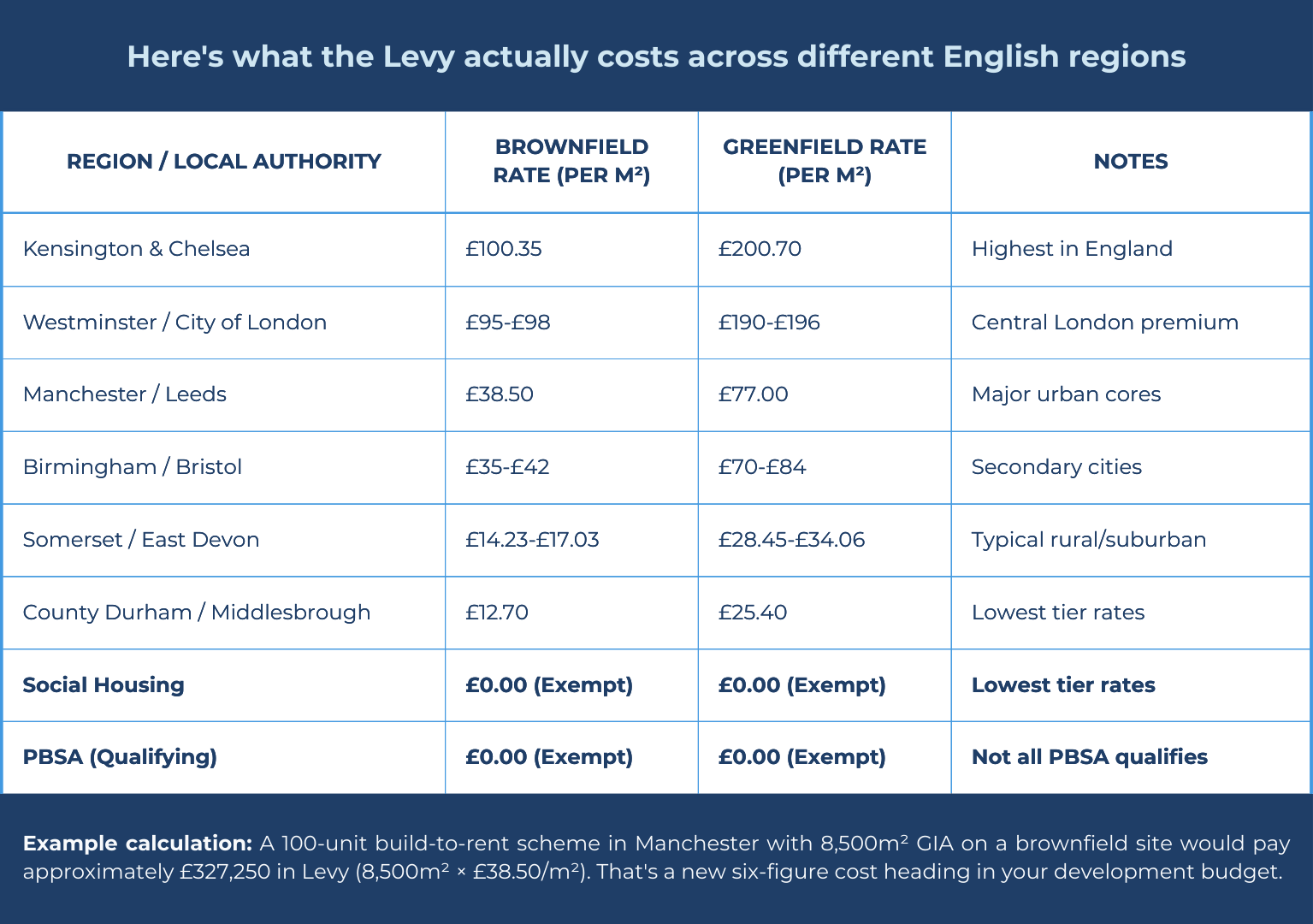
The charge is calculated per square metre of Gross Internal Area (GIA) for new residential development. Rates vary based on:
Location: Weighted by local house prices (higher-value areas pay more) Land Type: Brownfield sites get a 50% discount vs greenfield sites Use Type: Social housing and some purpose-built student accommodation (PBSA) may be exempt
Critical detail: For a development to qualify for the 50% brownfield discount, at least 75% of the site must meet the statutory definition of "previously developed land." Sites with marginal brownfield credentials won't qualify.
Levy Rates by Region (Representative Examples)
Strategic Implications for 2026 Projects
The October Rush: We're seeing a significant surge in Gateway 2 applications aimed at the September 2026 submission window to avoid the Levy. This will likely push BSR determination times back toward the 22-25 week range temporarily as the regulator handles the spike.
Appraisal Impact: For schemes in high-value areas, the Levy can add £150k-£500k+ to development costs. This affects:
Land acquisition pricing (reduce your residual land value calculation)
Scheme viability in marginal markets
Whether borderline HRB schemes (close to 18m threshold) are worth building as HRBs
Timing Strategy: If your scheme is ready for Gateway 2 submission by August 2026, there's a strong commercial case to submit before October to avoid the Levy. But don't sacrifice application quality for speed—a rejected application that has to be resubmitted after 1 October costs you both the delay AND the Levy.
11. The Gateway 2 Competence Checklist: Getting Duty Holder Declarations Right
"Competence" isn't just a box to tick—it's the BSR's primary filter for whether they trust your team to deliver a safe building. Here's your pre-submission checklist for Principal Designer and Principal Contractor competence declarations.
The Five Competence Pillars
Before submitting Gateway 2, ensure your Competence Declaration covers all five pillars for both the Principal Designer (PD) and Principal Contractor (PC):
1. The SKEB Framework Evidence
Does your declaration provide specific evidence of:
☐ Skills: Practical application of safety standards (e.g., fire-engineered designs, compartmentation detailing, complex MEP coordination in HRBs)
☐ Knowledge: Deep understanding of the Building Safety Act 2022 and Building Regulations Parts B (Fire), K (Protection from Falling), S (Infrastructure for EV Charging), and M (Accessibility)
☐ Experience: Portfolio of completed Higher-Risk Buildings or similar complex high-rise structures (even if pre-2023, demonstrate relevant experience)
☐ Behaviours: Evidence of a "safety-first" culture—track record of reporting mandatory occurrences, proactive identification of compliance issues, collaborative approach with Building Control
2. PAS Compliance
☐ Principal Designer: Verified assessment against PAS 8671:2022 (Competence of Principal Designers for Higher-Risk Buildings)
Is the PD on a recognized professional register? (RIBA, RICS, CABE with HRB-specific accreditation)
Can they demonstrate organisational systems for HRB work?
☐ Principal Contractor: Verified assessment against PAS 8672:2022 (Competence of Principal Contractors for Higher-Risk Buildings)
Does the PC have quality management systems specific to HRB construction?
Can they demonstrate supervision and oversight capability?
3. The "Serious Sanction" Audit
☐ Have you conducted a formal inquiry into the last 5 years of history for all lead duty holders?
☐ Does the declaration explicitly confirm that no "serious sanctions" (as defined by the BSR) have been issued against the PD or PC?
☐ If sanctions exist: Have you included the required mitigation statement explaining why they don't present a barrier to the current project? (This should be a detailed narrative, not a dismissive sentence)
What counts as a "serious sanction":
Prohibition notices from HSE or Building Control
Professional body disciplinary actions
Criminal convictions related to building safety
Enforcement actions under previous Building Acts
4. Organizational Capability
☐ Resource Capacity: Proof that the PD/PC firms have the manpower and resources to handle this project without "competence fatigue" (Can they resource this project alongside their other commitments?)
☐ Internal Supervision System: Description of how the organisation monitors its own staff on this project:
Who supervises junior staff making design/construction decisions?
What review and checking procedures exist?
How are competence gaps identified and addressed?
☐ HRB-Specific Systems: Evidence of:
Golden Thread information management capability
Change control procedures specific to HRB
Mandatory occurrence reporting processes
5. The Declaration Signing
☐ The declaration must be signed by you (the Client/Developer), not just the consultants
☐ The signatory understands they are personally attesting to the competence of their team under the Building Safety Act
☐ You've reviewed the evidence supporting the declaration yourself (don't just sign what your architect hands you)
Legal reality: Under the Building Safety Act 2022, you as the Client have criminal liability for ensuring your team is competent. The declaration puts your name to that assurance. If your Principal Designer or Contractor isn't actually competent and a safety failure occurs, "I trusted my architect to check" isn't a defence.
Common Competence Declaration Failures
The BSR has flagged these recurring issues in rejected applications:
Vague statements: "XYZ Architects are competent to deliver this project" without evidence
Generic CVs: Standard professional CVs that don't demonstrate HRB-specific knowledge or experience
Missing organizational detail: No explanation of how the firm manages HRB complexity at an organizational level (systems, procedures, resources)
Template declarations: Word-for-word identical declarations across multiple projects, suggesting no project-specific assessment
Unsigned or wrongly signed: Declarations signed by the consultant themselves rather than the Client, or electronic signatures without proper authorization evidence
How to Get Competence Right
Start early: Don't leave competence assessment to the week before Gateway 2 submission. Begin evaluating your PD and PC during procurement so you know you can declare their competence with confidence.
Demand evidence: Ask your PD and PC to provide you with the documentation you need to make the declaration: PAS assessments, CVs, project histories, systems documentation.
Be project-specific: Tailor the declaration to this building. Explain why this specific PD and PC are competent for this specific HRB, not just generically competent.
Get legal review: Have your solicitor review the declaration before you sign. You're taking on criminal liability—understand what you're signing.
Document your assessment: Keep a file showing how you satisfied yourself of competence. If challenged later, you need to demonstrate you conducted a reasonable assessment, not just rubber-stamped what you were told.
The 2026 Competence Reality
By 2026, the pool of consultants and contractors with proven HRB track records has grown. You're no longer pioneering with teams doing their first Gateway 2. Use this to your advantage: insist on teams with demonstrable HRB delivery. The premium you pay for experienced specialists is insignificant compared to the cost of rejection and redesign with an inexperienced team.
12. Looking Ahead: What to Expect in Late 2026 and Beyond
The Gateway regime continues to evolve. Here's what's on the horizon for late 2026 and into 2027:
The October 2026 Levy Implementation
As detailed in Section 10, the Building Safety Levy comes into effect for applications submitted from 1 October 2026 onwards. The immediate impact will be:
Application Surge: Expect Gateway 2 determination times to temporarily deteriorate in Q3-Q4 2026 as developers rush to beat the October deadline. If your scheme isn't ready by August 2026, plan for 20-25 week determination periods during this spike.
Market Segmentation: The Levy will accelerate the "design down" trend in marginal markets where the additional £50-£150/m² cost tips schemes from viable to unviable. Expect more 17-metre and 6-storey schemes in areas outside prime urban locations.
Continued BSR Reforms
The BSR's transition to standalone MHCLG body continues through 2026. Expect:
Further guidance refinements
Possible fee structure changes
More transparent performance reporting
Potentially faster approval times as the Innovation Unit scales up
The government's 1.5 million homes target means political pressure to improve Gateway throughput without compromising safety.
Industry Maturation
As more projects go through Gateway 2 and 3 successfully, industry understanding improves:
Standard approaches emerge for common building types
Template compliance narratives (though still requiring project-specific tailoring)
Consultant market develops specialists in Gateway applications
Software tools for Golden Thread management improve
First-mover disadvantage is diminishing. By 2026, it's possible to learn from others' successes and failures rather than pioneering yourself.
Potential Legislative Refinement
The House of Lords Industry and Regulators Committee launched an inquiry in late 2025 into the BSR's role and impact on housing delivery. Potential outcomes:
Clarification of grey areas in the legislation
Possible threshold adjustments (though politically difficult post-Grenfell)
Streamlining of administrative requirements
Balance between safety and housing delivery
Watch for legislative changes through 2026-2027 that could further refine the regime.
Conclusion: Gateway 2 in 2026—Navigable, But Demanding
The Gateway 2 crisis of 2024-2025 was real: rejection rates reported around 40-50% during early rollout, average waits of 22+ weeks (with some cases significantly longer), £millions in holding costs, and developers avoiding HRB work altogether. But the situation has improved materially by late 2025 and continues improving through 2026.
Approval rates reported by the BSR had climbed to around 73% by late 2025, and determination times have stabilized (though still exceeding statutory targets for many applications). The Technical Specialist Teams are processing cases more efficiently, and industry understanding of what constitutes a "complete" application has matured significantly.
The developers succeeding at Gateway 2 aren't the ones hoping for leniency or finding workarounds. They're the ones who accept the regime as the new normal and build capability accordingly:
They treat Gateway 2 like securing planning permission: a strategic exercise requiring structured submissions, clear compliance narratives, and evidence-based arguments.
They invest upfront in getting it right: engaging the BSR early, appointing competent specialists with demonstrable PAS assessments, building Golden Thread systems from day one, and maintaining change control discipline throughout the project.
They understand why applications fail: incomplete information, weak compliance narratives, poor coordination, generic declarations, and document dumps—and they deliberately avoid these failure modes.
They leverage the 2025-2026 reforms: staged submissions for complex schemes, Technical Specialist Team capacity, clearer BSR guidance, and "Approval with Requirements" conditional routes.
They plan for the Building Safety Levy: factoring the October 2026 implementation into development appraisals and timing Gateway 2 submissions strategically.
Programme extensions of 6-18 months have been reported across the industry, but they're becoming more predictable as understanding improves. Gateway 2 approval is no longer a coin flip—with proper preparation, you're looking at approval rates around 73% and determination times of 16-22 weeks for well-structured applications. That's manageable if you plan for it from site acquisition onwards.
The regime isn't going away. Grenfell ensured that. But Gateway 2 is now a solved problem for developers willing to invest in understanding it. The question isn't whether to engage with the Gateway regime—it's whether you're prepared to do it well enough to make HRB development commercially viable in your business.
If you need technical coordination for Gateway 2 applications, fire strategy development, or building safety compliance, contact Sovatech Consulting. We'll coordinate the specialists and evidence demonstrating your HRB meets Building Safety Regulator requirements—helping you navigate Gateway 2 efficiently and pass first time.
Editorial Note on Data Sources
This guide draws on multiple information sources to provide developers with practical insight into Gateway 2 performance and requirements:
Regulatory sources: Building Safety Regulator performance updates, Health and Safety Executive reports to parliamentary committees, statutory guidance published by DLUHC
Parliamentary evidence: Responses to parliamentary questions, Select Committee evidence sessions, Freedom of Information Act requests published by industry bodies
Industry reporting: Home Builders Federation surveys, Construction Leadership Council guidance, RICS and RIBA professional updates, developer trading statements
Legal sources: Technology and Construction Court judgments, enforcement notices, Building Safety Act 2022 and associated regulations
Where specific figures are cited (approval rates, determination times, rejection percentages), these reflect information published by the BSR, reported in parliamentary evidence, or surveyed by recognized industry bodies during 2024-2025. The regulatory environment continues to evolve, and developers should verify current performance data directly with the BSR for project-specific planning.
The strategic conclusions and practical guidance in this article are based on observable industry trends and regulatory practice during the Gateway 2 rollout period, informed by the author's experience coordinating building safety compliance for HRB developments.
