

Future Homes Standard Implementation: Timelines, Transitional Traps, and the Turnkey Solutions Already in the Ground
On 28 April 2026, I attended a webinar hosted by GTC and the National Federation of Builders on the practical implementation of the Future Homes Standard. The session brought together regulatory specialists, heat network operators, and developers already delivering FHS-compliant homes — and it clarified several critical points that every SME developer needs to understand.
The Future Homes Standard was laid before Parliament on 24 March 2026. The Approved Documents are published. The statutory instruments are in place. This is no longer a consultation-stage proposal — the legislation has been laid, Approved Documents published, and implementation dates confirmed.
But the detail of the transitional arrangements is where developers will either protect their programmes or get caught out. And the gap between what many people think the rules say and what they actually say is wider than most realise.
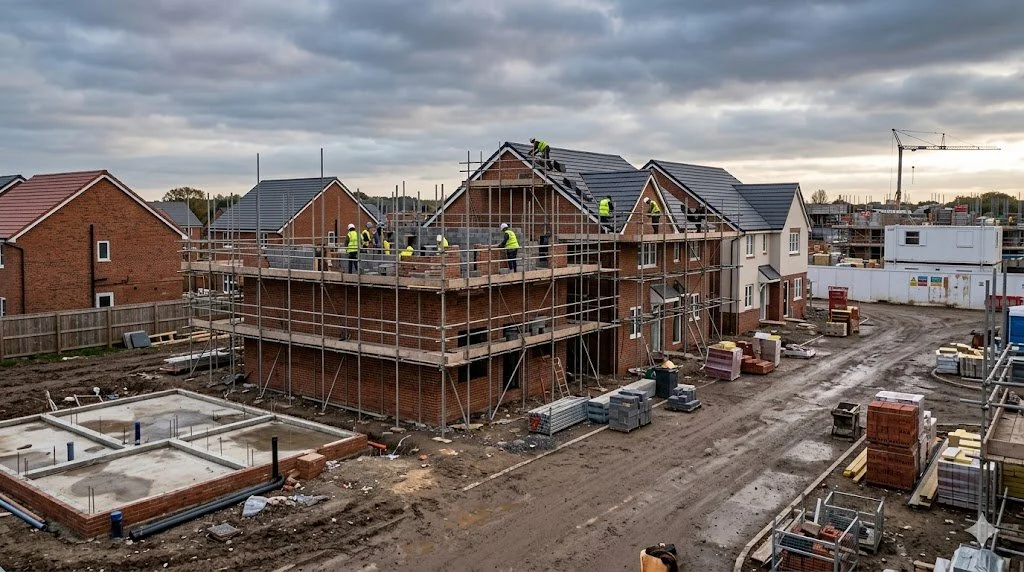
The Confirmed Timelines — And the Distinction Most Developers Are Getting Wrong
Here are the confirmed implementation dates:
Non-Higher-Risk Buildings (most residential development): The Future Homes Standard comes into force on 24 March 2027. A 12-month transitional period runs until 24 March 2028.
Higher-Risk Buildings (18m+ or 7+ storeys): The FHS comes into force on 24 September 2027, with separate transitional provisions reflecting the complexity of the Gateway process.
These dates are set in legislation and should be treated as fixed for programme planning purposes.
The Critical Distinction: Building Control Applications, Not Planning Applications
This is the single most important point from the webinar — and the one most likely to catch developers off guard.
The transitional arrangements are triggered by building control applications, not planning applications. Specifically, a building notice, an initial notice, or a full plans application must be submitted to the relevant building control body before the cut-off date.
For non-HRB development, this means a building control application must be submitted before 24 March 2027, and construction must commence on the relevant building before 24 March 2028. If both conditions are met, that building may be constructed to the current Part L 2021 standard.
For HRBs, a valid Gateway 2 application must be submitted to the Building Safety Regulator before 24 September 2027. That application must ultimately be successful — though the decision can be received after the cut-off date. If a Gateway 2 application is rejected and resubmitted after 24 September 2027, the resubmitted application must comply with FHS requirements.
This is a crucial distinction. Many developers are working on the assumption that having a planning application submitted or even approved before the deadline is sufficient. It is not. Planning permission and building control approval are separate regulatory processes. You can have full planning permission and still be required to build to FHS standards if your building control application is submitted after 24 March 2027.
The practical implication is clear: developers who want to build to current Part L 2021 standards need to have their building control applications submitted — not just their planning applications — before the deadline. For sites currently in the planning system, this means progressing building control submissions in parallel with planning, not sequentially.
The Transitional Trap Checklist
To build under Part L 2021 rather than FHS, you must meet all conditions:
Non-HRB:
Building control application (building notice, initial notice, or full plans) submitted before 24 March 2027
Applies per building, not per site
Construction commenced on that building before 24 March 2028
HRB:
Valid Gateway 2 application submitted before 24 September 2027
Application must not be rejected before, on, or after that date
Failure on any point → Full FHS compliance required.
Per-Building, Not Per-Site
The transitional provisions apply at the level of individual buildings (as defined under the Building Regulations), rather than across a wider development site. This is stricter than some previous Building Regulation transitions and has significant programme implications.
On a 50-unit scheme, for example, you cannot submit a building notice for plots 1–5, commence those plots, and then claim transitional protection for the remaining 45 plots. Each individual building must have its own building control application submitted before the deadline and its own construction commenced within the transitional window.
This means developers should expect — and plan for — a surge in plot-level building control registrations before March 2027. As the deadline approaches, competition for building control approvals, energy assessors, and compliant supply chain capacity is likely to intensify. Building control bodies are already anticipating increased workloads, and capacity constraints could create bottlenecks for developers who leave submissions late.
What "Commence" Actually Means
The definition of "commence" is critical. Under the current regulations, commencement includes drainage and foundation work — not just superstructure construction. However, site clearance, earthworks, hoarding, and enabling works alone do not count. Each individual building must have started meaningful physical construction to be deemed commenced.
There is ongoing discussion within the industry about whether building control bodies will increasingly require evidence of ground-floor-level structure being in place, moving beyond the traditional "pour of foundations" threshold to prevent tokenistic commencement claims. While the statutory definition still technically includes foundation work, the direction of travel suggests a higher evidential bar.
In practice, developers should assume that building control bodies will require clear, auditable evidence of meaningful commencement. Date-stamped site photographs, foundation inspection records, and building control sign-off documentation should be retained systematically to demonstrate compliance if challenged during the transitional period. Keeping a contemporaneous paper trail is cheap insurance against a costly dispute in 2028.
Legacy Transitional Provisions — Revoked
The government has also revoked earlier transitional arrangements from 2013 and 2021 that allowed some projects to continue building to 2010 energy efficiency standards. Any uncommenced plots relying on those legacy provisions have now had their "sunset clauses" triggered — they must comply with the Future Homes Standard regardless of when the original building control application was submitted.
For multi-phase development sites with long build-out programmes, this introduces a potential viability gap between earlier phases (built to older standards at lower cost) and later phases (now requiring full FHS compliance at higher specification and cost). Developers with uncommenced later phases should revisit their viability assessments now, before the transitional window closes.
The Home Energy Model: Promise and Delay
One of the most insightful moments in the webinar came from Adam Tkacz, GTC's Business Development Director for Sustainable Heat, who described the shift from SAP to HEM with a memorable analogy: "SAP is like using the old paper A-to-Z route maps. HEM is like using Google Maps."
The Home Energy Model represents a fundamental upgrade in how building energy performance is assessed. Where SAP uses monthly averages and simplified assumptions, HEM simulates building physics at half-hourly intervals — capturing the real-world interaction between heating systems, solar generation, battery storage, occupant behaviour, and weather patterns.
An important distinction: SAP 10.3 will function as the compliance methodology at FHS launch — the tool used to demonstrate that a building meets the regulatory requirements. The Home Energy Model represents the longer-term performance-based framework that will ultimately replace it. The difference matters because compliance and real-world performance are not the same thing. A building can pass the SAP test while underperforming in practice — and HEM is designed to close that gap.
When the Future Homes Standard comes into force on 24 March 2027, SAP 10.3 will be the sole approved compliance methodology. HEM will not become available as an approved FHS compliance route until at least three months after FHS launch — mid-2027 at the earliest. Both methodologies will then run in parallel for a minimum of 24 months, after which SAP 10.3 will be withdrawn and HEM will become the sole compliance route.
There are indications that HEM implementation may face further delays as the industry and software providers work through the technical complexity of the new methodology. For developers, this creates a practical challenge: you need to design and demonstrate compliance using SAP 10.3 now, while knowing that the methodology will eventually be replaced by HEM — which may assess your designs differently.
The pragmatic approach is to design to FHS requirements using SAP 10.3 as the compliance tool, while understanding the principles behind HEM so that designs are robust under both methodologies. Working with energy assessors who are already engaging with HEM's technical framework will help manage this transition — and this is precisely where Sovatech's technical coordination role adds value, bridging the gap between "passing the test" and "the building actually working.”
The Energy Trilemma: Why This Isn't Just About Carbon
The webinar framed the Future Homes Standard within the context of the Energy Trilemma — the framework used by the World Energy Council to describe three competing priorities that every energy system must balance simultaneously:
Energy Security: Reliable, uninterrupted supply that isn't dependent on volatile international markets. Recent geopolitical instability — particularly the Iran conflict and its impact on global gas prices — has made this viscerally real. The UK's continued dependence on imported gas leaves households exposed to price shocks over which they have no control.
Energy Affordability: Accessible, affordable energy for all households. Energy bills are consistently named by the public as the primary driver of the cost-of-living crisis. Rising wholesale gas prices have intensified political pressure on the government to accelerate the transition away from fossil fuel heating.
Environmental Sustainability: Reducing carbon emissions to meet the UK's legally binding 2050 net-zero target. Homes account for 14% of UK carbon emissions — the second highest-emitting sector in the country.
The Future Homes Standard is the government's attempt to address all three simultaneously. Heat pumps powered by UK-generated renewable electricity reduce dependence on imported gas (security). Combined with solar PV and battery storage, they can reduce household energy bills (affordability). And by delivering homes that produce at least 75% less carbon than 2013 standards, they contribute directly to net-zero targets (sustainability).
But for developers, the trilemma creates a practical challenge: how do you deliver homes that meet all three objectives without grid reinforcement delays, supply chain bottlenecks, and additional costs that erode viability?
This is where the turnkey solutions already being deployed become directly relevant.
Turnkey Heat Network Solutions: What's Already in the Ground
Gareth Copland, Operations Director at Metropolitan (part of the BUUK Infrastructure group), presented on how regulated heat networks are already delivering FHS-compliant heating at scale — with solutions specifically designed for the housebuilding sector.
BUUK Infrastructure is the UK's leading independent provider of last-mile utility networks, employing over 2,000 people and operating networks serving more than two million homes. Through its group companies — GTC for multi-utility infrastructure, Metropolitan for heat networks, and Power On for complex electricity solutions — BUUK is the only partner to the new-build sector delivering infrastructure for all utilities from a single source.
The key insight from Gareth's presentation was that regulated heat networks address the Energy Trilemma directly by solving the grid capacity problem that individual heat pumps create.
Community Heat Hubs
GTC's Community Heat Hub model uses large-scale air-source heat pumps in a centralised hub, delivering heat and hot water to every home through a highly insulated pipe network operating at 60°C. This approach combines both FHS notional specifications — heat pumps and heat networks — in a single, future-proofed solution delivering 75–80% carbon reduction from day one.
The commercial advantages for developers are notable. Community Heat Hubs can reduce the overall site peak electricity demand by 15% compared to individual air-source heat pumps — reducing the need for costly and time-consuming grid reinforcement. Thermal stores within the hub charge overnight when electricity prices are at their lowest, then switch off during peak price periods — reducing customer bills by up to 20% compared to individual heat pumps.
The solution is already live and operational at Taylor Wimpey's Chilton Woods in Suffolk (up to 950 connections), Taylor Wimpey's Swinnow Park in Wetherby (762 homes), and Vistry's The Gateway in Bexhill (801 homes). These are not pilot projects — they are delivering heat to real homeowners on occupied developments.
Networked Ground Source Heat Pumps
GTC's partnership with Kensa — the UK's leading ground source heat pump manufacturer — offers a complementary solution. Each home receives an individual ground source heat pump connected to a shared underground borehole network. Kensa's compact "Shoebox" unit fits inside the home beneath the hot water cylinder, eliminating external units and visual impact.
The grid capacity advantage is even more pronounced with ground source. Networked GSHPs deliver 3–4 kWh of heat for every 1 kWh of electricity consumed, requiring no more grid capacity than gas-heated homes. For developers facing grid connection constraints — an increasingly common challenge — this removes one of the most significant barriers to FHS compliance.
GTC provides the funded solution including design, borehole drilling, and network installation, carrying the geological risk through firm quotations. Metropolitan operates the network long-term. Heat networks are being brought under Ofgem regulation from 2025–2026 onwards, giving homeowners statutory protection on price and service levels equivalent to other regulated utilities.
As with all infrastructure strategies, suitability will depend on site-specific constraints, commercial structures, and long-term operational considerations. These solutions won't be right for every scheme — but for developers facing grid capacity challenges, managing the transition to low-carbon heating, or looking for turnkey delivery models that reduce upfront cost and ongoing risk, they represent a proven and commercially available option.
this image was generated with the assistance of AI
Cosmeston Farm: A Flagship Net-Zero Development
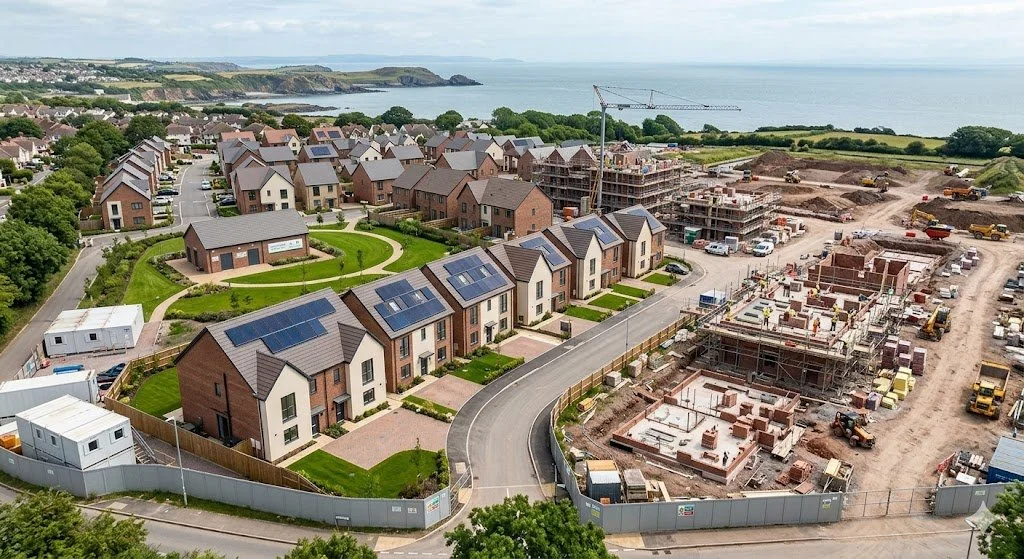
Matt Johnson presented the case study that brought the theory to life: Cosmeston Farm in Penarth, Vale of Glamorgan — one of the UK's largest net-zero carbon housing developments and one of the most significant residential sustainability projects in Europe.
The scheme, contracted by the Welsh Government with Barratt Redrow, will deliver 576 new homes designed to achieve net-zero carbon in operation. Fifty percent of the homes will be affordable, including 219 for social rent. The development also includes a new primary school, open space, and active travel routes across the 22-hectare site.
Every home will be heated by a networked ground source heat pump and powered by photovoltaic panels and home batteries. GTC has been selected to deliver the complete Smart Home energy and utility infrastructure — combining networked GSHPs, smart controls and optimisation, grid flexibility services, home battery storage, and GTC-owned electricity and water networks as a single seamless service.
What makes Cosmeston particularly significant is the monitoring framework. GTC will capture detailed, real-world performance data from the heat pumps, solar PV, batteries, smart controls, and the local electricity network across the entire development. Cardiff University has been independently appointed to assess and verify the zero-carbon performance data — providing the kind of rigorous, third-party-verified evidence that the industry needs to demonstrate these systems work at scale.
GTC supported Barratt Redrow from the earliest feasibility stage, shaping the technical and commercial strategy that secured the Welsh Government-led project. Oliver Novakovic, Technical and Innovation Director at Barratt Redrow, described Cosmeston as "a transformational step in how we design and build the next generation of zero-carbon communities."
The scheme is designed to exceed — not just meet — the Future Homes Standard. It's a proof point that the technology, the delivery models, and the commercial frameworks exist. The question for the wider industry is not whether these solutions work, but how quickly they can be scaled.
What This Means for SME Developers
The webinar crystallised several practical takeaways:
The transitional window is tighter than it appears. If you want to build to current Part L 2021 standards, you need building control applications submitted before 24 March 2027 — per building, not per site. That's less than 11 months away. For schemes currently in planning or pre-commencement, the clock is ticking.
The building control vs planning application distinction will catch people out. Make sure your team — and your building control body — are aligned on what triggers transitional protection. Don't assume a planning permission is sufficient.
Document commencement rigorously. Date-stamped photographs, foundation inspection records, and building control sign-off documentation should be retained systematically. If commencement is challenged during the transitional period, a contemporaneous paper trail is your best defence.
HEM delays add uncertainty but shouldn't delay preparation. Design to FHS requirements using SAP 10.3 as the compliance methodology, but understand that HEM will eventually replace it. Work with energy assessors who are engaging with HEM's framework now.
Grid capacity is a real constraint — but it has solutions. Community Heat Hubs and Networked GSHPs can reduce or eliminate the need for grid reinforcement on your sites. If grid connection is holding up your programme, these are worth investigating — though suitability will always be site-specific.
Revisit viability on multi-phase sites. The revocation of legacy transitional provisions means later phases on long-running sites now require full FHS compliance. If your viability assessment assumed older standards for later phases, it needs updating.
Energy independence is now a selling point, not just a compliance cost. In a market where energy bills are front-page news and fossil fuel dependence is a tangible risk, homes that generate their own energy, store it, and heat efficiently are premium products. The developers who frame FHS compliance as a market advantage — not just a regulatory burden — will win the sales conversation.
The Future Homes Standard is coming. The dates are set. The technology is available. The developers who are preparing now will absorb the transition smoothly. Those who wait until March 2027 will face cost escalation, supply chain competition, and programme delays that could have been avoided.
The webinar made one thing clear: the early movers aren't waiting for certainty. They're building it.
If you're an SME developer navigating the Future Homes Standard transition and need technical support — from reviewing your transitional timeline and building control strategy to coordinating energy specifications and compliance documentation — Sovatech Consulting can help. We provide Head of Technical-level expertise to ensure your projects are prepared for 2027 and beyond. Contact us to discuss your programme.
