

BNG Exemption for Small Sites: What the 0.2 Hectare Threshold Means in Practice
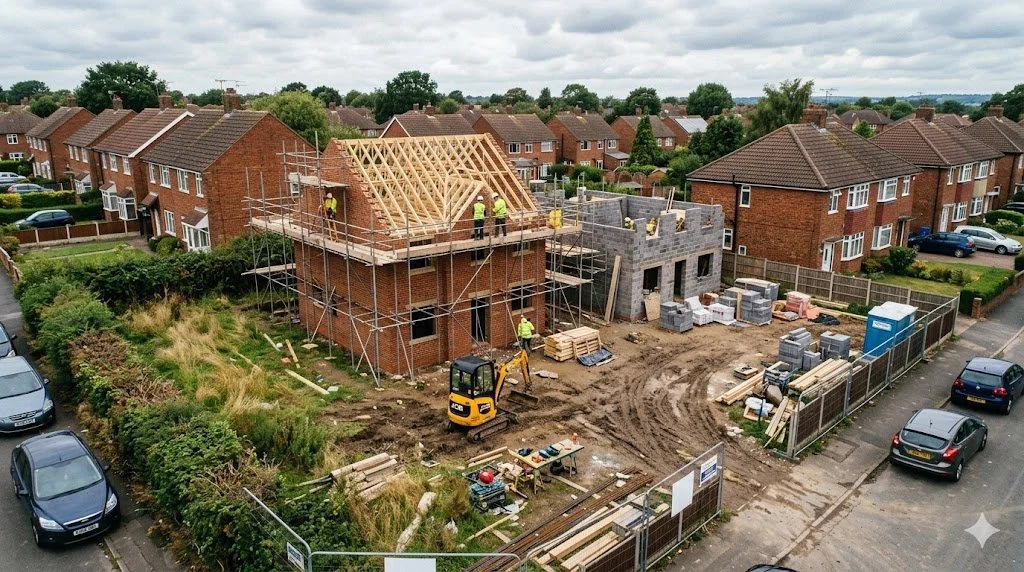
When Biodiversity Net Gain became mandatory for major development in February 2024 and for small sites in April 2024, the principle was straightforward: all development should leave nature in a measurably better state. The 10% net gain requirement, measured through the Statutory Biodiversity Metric, applied to virtually every planning application that involved building homes.
Two years on, the government has acknowledged what many SME developers and local planning authorities have been saying throughout: the system, as designed, is disproportionate for the smallest sites.
In mid-April 2026, Defra published its formal response to the consultation on improving BNG for minor, medium and brownfield development. The headline change — and the one with the most immediate practical impact for developers — is the confirmation of a new area-based exemption for sites of 0.2 hectares or below. Subject to parliamentary scheduling, this exemption is expected to come into force before 31 July 2026.
The government estimates that this single change will exempt approximately 50% of residential planning permissions that currently fall within mandatory BNG. By some calculations (Wildlife and Countryside Link analysis), it affects 77% of all planning applications in England by volume.
That's a significant policy shift. But as with all BNG matters, the detail determines whether it actually helps your specific project — or whether you still need to comply
Why the Government Changed Course
The rationale for the 0.2 hectare exemption is rooted in proportionality — or rather, the lack of it under the current regime.
Research into over 1,000 approved planning applications demonstrated that for the smallest sites, the administrative cost of BNG compliance — ecological surveys, metric calculations, legal fees for 30-year habitat management agreements, competent person declarations — was frequently disproportionate to the biodiversity gain actually being delivered. In some cases, the cost of the BNG process exceeded the value of the biodiversity outcome it was supposed to produce.
For a developer building two or three homes on a 0.15 hectare infill plot, the current regime requires the same fundamental process as a 200-unit greenfield scheme: baseline habitat survey, UKHab classification, Statutory Biodiversity Metric calculation (or Small Sites Metric), habitat management plan, and — if on-site delivery isn't feasible — the purchase of off-site biodiversity units or statutory credits starting at around £42,000 per unit for low-distinctiveness habitats and rising significantly — in some cases above £600,000 per unit — for high-distinctiveness habitats.
The government's position — expressed in ministerial commentary and summarised in the formal consultation response — is that for the smallest sites, the administrative burden is disproportionate to the biodiversity outcomes achieved. By exempting them, local planning authorities can focus their limited ecological assessment capacity on larger developments where 10% gains genuinely move the needle for nature recovery.
This isn't without controversy. An influential coalition of over 120 organisations — including Wates Group, the UK Green Building Council, the Green Construction Board, and dozens of ecological consultancies — wrote to the government urging a much lower threshold of 0.1 hectares, arguing that even modest areas of green infrastructure in urban areas deliver significant social and environmental benefits. The Wildlife Trusts calculated that setting the threshold at 0.2 hectares removes a combined area equivalent to Windsor Forest from BNG protection.
The government proceeded with 0.2 hectares regardless. For developers, the policy decision is made. The question now is what it means in practice.
What the 0.2 Hectare Exemption Actually Says
The exemption is area-based, not impact-based. This is an important distinction from the existing de minimis exemption, which is triggered by the amount of habitat affected (less than 25 square metres of non-priority habitat and less than 5 metres of linear habitat). The new 0.2 hectare exemption is a completely separate category.
The test is simple in principle: if the total site area within your red line boundary is 0.2 hectares or below, BNG does not apply. You do not need to submit a biodiversity metric calculation, a baseline habitat plan, a biodiversity gain plan, or a 30-year habitat management and monitoring plan. You do not need to purchase off-site biodiversity units or statutory credits.
But there are two critical exceptions that can override the exemption — and both apply regardless of site size.
The Quick Test
A site is exempt from mandatory BNG only if all three conditions are met:
1. Site Area: The total area within the red line boundary is 0.2 hectares or below.
2. No Priority Habitat: No habitats listed under Section 41 of the Natural Environment and Rural Communities (NERC) Act 2006 are present on site and impacted by the development.
3. No Irreplaceable Habitat: No ancient woodland, blanket bog, ancient or veteran trees, or other irreplaceable habitats are affected.
If any of these conditions are not met, the 10% BNG requirement applies in full.
Exception 1: Priority Habitat
Priority habitats are those listed under Section 41 of the NERC Act 2006 — the habitats the government considers to be of principal importance for the conservation of biodiversity in England. They include species-rich grassland, lowland heathland, traditional orchards, hedgerows of ecological importance, coastal habitats, and dozens of other classifications.
This is where developers can get caught out. A site might be well under 0.2 hectares — a 0.1 hectare infill plot, for example — but if an ecological survey identifies priority habitat on the site, the exemption falls away and full BNG compliance is required.
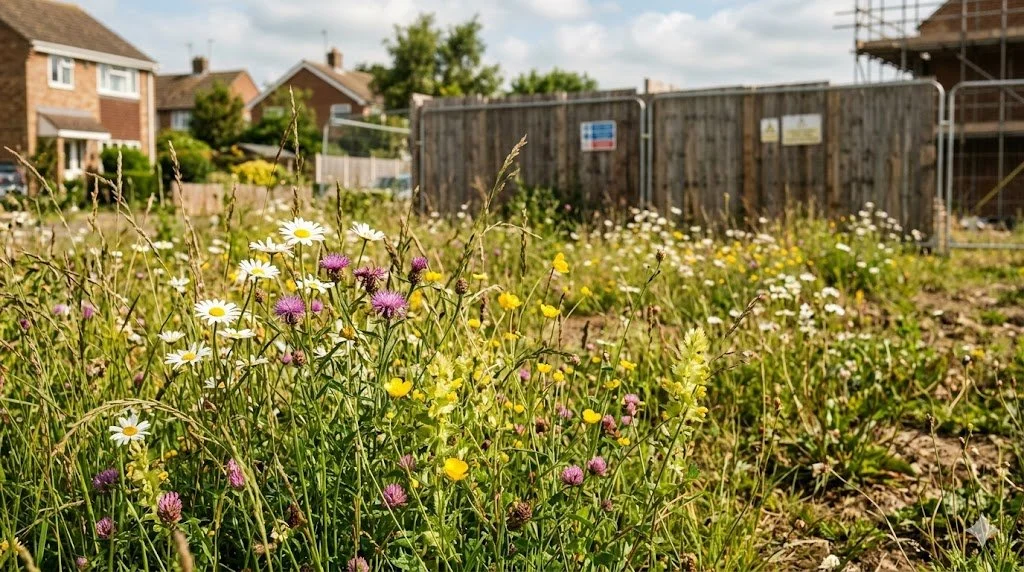
The practical implication is clear: even on exempt-sized sites, you need to understand what's on the ground. A scrubby patch of land that looks like "nothing" to a developer might be classified by an ecologist as species-rich grassland or lowland mixed deciduous woodland — both priority habitats. Assuming exemption without checking is a fast route to a delayed or refused application.
Exception 2: Irreplaceable Habitat
It's important to distinguish irreplaceable habitats — such as ancient woodland and blanket bog — which are subject to a separate and much stricter policy test under the National Planning Policy Framework.
Where irreplaceable habitats are affected, planning permission is typically refused unless there are wholly exceptional reasons and a suitable compensation strategy can be demonstrated. This applies regardless of site size, meaning the 0.2 hectare exemption offers no practical relief in these scenarios. A 0.08 hectare site containing a fragment of ancient woodland faces the same near-automatic refusal as a 50 hectare strategic site encroaching on the same habitat type.
Irreplaceable habitats are not simply "priority habitat plus" — they represent a fundamentally different planning regime with a much higher evidential bar for approval. Developers should treat any indication of irreplaceable habitat on or adjacent to their site as a red flag requiring immediate specialist ecological advice.
How the 0.2 Hectare Threshold Is Measured
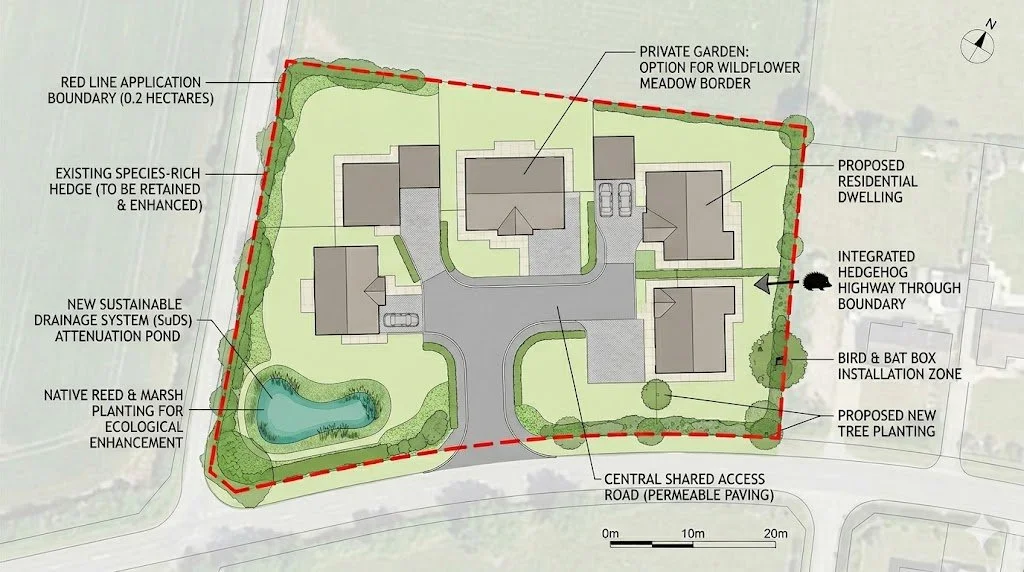
The exemption is based on the total site area within the red line boundary — not the building footprint, not the area of habitat impacted, and not the net developable area. This is the same red line boundary that defines the extent of the planning application.
For developers, this means the red line boundary you draw directly determines whether you qualify. On tight infill sites, where the red line closely follows the site boundary, this is straightforward. But on sites where access roads, visibility splays, or drainage connections extend the red line beyond the core development area, the total area can creep above 0.2 hectares even where the actual development footprint is modest.
It's worth reviewing your red line boundary carefully before assuming exemption.
However, a word of caution: local planning authorities are alert to attempts to artificially reduce site area to fall below regulatory thresholds. Deliberately segmenting a larger site into multiple sub-0.2 hectare applications, or excluding land that is clearly necessary for the development to function (such as access, services, or drainage), is likely to be challenged. Planning officers are trained to identify what might be termed "red line gerrymandering" — and a refusal on these grounds creates delays that far outweigh the cost of BNG compliance on the original site.
The exemption is designed to relieve the burden on genuinely small sites, not to provide a mechanism for avoiding BNG on larger developments through creative boundary drawing.
For developers, a brief ecological walkover assessment — which might cost £300–500 — gives you certainty about both habitat classification and site eligibility. That's a fraction of the cost of a full BNG metric assessment, and it prevents the scenario where a planning officer identifies priority habitat on your site after you've submitted an application without BNG documentation.
What Else Is Changing Alongside the 0.2 Hectare Exemption
The 0.2 hectare exemption is the headline change, but it's part of a broader package of BNG reforms confirmed in the April 2026 government response. Understanding the full package matters because several changes interact with each other.
Removal of the Self-Build and Custom-Build Exemption
The current exemption for small-scale self-build and custom-build developments (up to 9 dwellings on sites of 0.5 hectares or less) is being removed. The government's reasoning is that many self-build projects will now fall within the new 0.2 hectare exemption instead, making the separate self-build category redundant. The self-build exemption was also widely seen as being abused and unworkable in practice.
For self-builders on sites larger than 0.2 hectares, this is a material change. Where previously a qualifying self-build project on a 0.3 hectare site would have been exempt, after July 2026 it will need to comply with full BNG requirements. Self-builders and custom housebuilders should check their site area now and plan accordingly.
New Exemption for Temporary Permissions
Developments granted temporary planning permission for a maximum of five years will be exempt from BNG. This recognises that 30-year habitat management commitments are impractical and disproportionate for inherently temporary uses.
Amended Biodiversity Gain Hierarchy for Minor Development
For minor developments that remain within the BNG regime (i.e., those above 0.2 hectares but below major development thresholds), the biodiversity gain hierarchy is being amended. Currently, on-site delivery is preferred over off-site provision, which in turn is preferred over statutory credits. The change will give off-site biodiversity gains the same preference as on-site habitat creation for minor development.
This is a pragmatic recognition that small sites often lack the space for meaningful on-site habitat creation. Allowing equal preference for off-site provision gives developers more flexibility and supports the development of the off-site biodiversity market — though the government acknowledges this creates tension with market viability, given that the combined effect of the 0.2 hectare exemption and potential brownfield exemptions could reduce off-site market transactions by up to 48%.
Additional Exemptions Later in 2026
The government has confirmed that further exemptions will be introduced later in 2026 for developments whose primary objective is to conserve or enhance biodiversity, and for developments enhancing parks, playing fields, and public gardens.
Brownfield Consultation — The Bigger Question
Alongside the confirmed reforms, Defra has launched a separate consultation on a targeted BNG exemption for brownfield residential development, testing site area thresholds of up to 2.5 hectares. The consultation closes on 10 June 2026. To qualify as brownfield under the proposed definition, at least 75% of the site must be previously developed land — mirroring the approach used in the Building Safety Levy regulations.
If confirmed, a brownfield exemption at this scale would be transformative — particularly for urban regeneration and the redevelopment of previously developed land. However, the government's own impact assessment acknowledges the significant risk to the emerging off-site biodiversity market.
For developers working primarily on brownfield sites, this consultation is worth responding to. The outcome will directly affect project viability and compliance costs for years to come.
What "Exempt" Actually Means — And What It Doesn't
This is the point that risks being lost in the headline coverage: exemption from BNG does not mean exemption from all environmental responsibility.
The government has been explicit that developments exempt from the mandatory 10% net gain requirement remain subject to environmental protections through the National Planning Policy Framework and wider regulatory requirements. Planning applications can still be refused where a local planning authority determines that significant harm to biodiversity cannot be adequately avoided, mitigated, or compensated — even on an exempt site.
NPPF paragraph 180 still applies. Protected species legislation still applies. The duty on public authorities under Section 40 of the NERC Act to have regard to the conservation of biodiversity still applies. Tree Preservation Orders, hedgerow regulations, and local wildlife site designations still apply.
What the exemption removes is the specific requirement to demonstrate a 10% measurable net gain using the statutory metric, submit a biodiversity gain plan, and secure a 30-year habitat management and monitoring commitment. It removes the administrative framework — not the underlying environmental principle.
For developers, this means that even on exempt sites, good practice remains good practice. Avoiding unnecessary habitat destruction, retaining mature trees and hedgerows where feasible, and designing layouts that accommodate existing ecological features will still support smoother planning outcomes and reduce the risk of ecological objections.
Practical Implications for SME Developers
Timing: Don't Jump the Gun
The reforms are expected to come into force before 31 July 2026, subject to parliamentary scheduling. Until that date, the current BNG requirements remain fully in force. If you're submitting a planning application before the regulations change, you must comply with the existing regime — including the Small Sites Metric for minor development.
Assuming exemption before the legislation is enacted is a reliable way to land a refusal or a lengthy delay. If your project timeline allows, there may be value in checking whether submitting after the summer changes your BNG strategy. But delaying an application purely to avoid BNG carries its own risks — planning policy can change, and the July date is subject to parliamentary scheduling, not guaranteed.
The pragmatic approach is to prepare your application under the current rules while monitoring the legislative timeline. If the exemption comes into force before your submission date, you can adjust. If it doesn't, you're not caught unprepared.
Check Your Site Area — Precisely
The difference between qualifying and not qualifying comes down to whether your red line boundary is at or below 0.2 hectares. For sites close to this threshold, precision matters. Commission a topographical survey or use accurate OS mapping to confirm your site area. Don't estimate or eyeball it from Google Maps.
Remember: this is the total area within the red line boundary, not the building footprint or net developable area.
Screen for Priority and Irreplaceable Habitats
Even on sites well under 0.2 hectares, the presence of priority or irreplaceable habitat triggers full BNG compliance — or, in the case of irreplaceable habitat, a near-automatic refusal. Before assuming your site is exempt:
Check Defra's Magic Map Application (magic.defra.gov.uk) for priority habitat inventory data and ancient woodland inventory in your area. Cross-reference with local wildlife site designations and any ecological data held by your local biological records centre. Review Natural England's ancient woodland standing advice if woodland is present on or adjacent to the site.
If there's any uncertainty, a brief ecological walkover assessment gives you certainty. It's significantly cheaper than commissioning a full BNG metric assessment, and it prevents the scenario where a planning officer identifies a habitat issue after you've submitted an application without appropriate documentation.
Understand the Interaction with Self-Build Changes
If you're developing self-build or custom-build homes on sites larger than 0.2 hectares, note that the current self-build exemption is being removed. You will need to comply with full BNG from July 2026 onwards. Plan your metric assessment and biodiversity gain plan accordingly — and budget for it.
Factor in the Brownfield Consultation
If you're working on brownfield sites between 0.2 and 2.5 hectares, the outcome of the brownfield consultation (closing 10 June 2026) could significantly affect your BNG obligations. Monitor this closely and consider responding to support proportionate outcomes for your development type
The Bigger Picture
The 0.2 hectare exemption represents a meaningful recalibration of how BNG applies to the smallest developments. It acknowledges what the industry has argued since mandatory BNG was introduced: the administrative burden of the current system is disproportionate for sites where the ecological impact — and therefore the potential for meaningful biodiversity gain — is limited.
But it's a recalibration, not a retreat. The government has been clear that BNG remains a "world-leading environmental policy" and that its commitment to nature recovery through the planning system is unchanged. Defra reports that BNG is already preventing between 6,000 and 10,000 hectares of habitat loss annually — an area roughly the size of Nottingham — and is prompting earlier, more nature-led design decisions across the industry.
The reforms focus effort on larger developments with greater potential to deliver environmental outcomes, while reducing friction for smaller schemes. For SME developers, this is broadly positive. Fewer small sites will require the full BNG process, reducing costs and uncertainty. But the priority habitat exception, the irreplaceable habitat regime, the removal of the self-build exemption, and the continued application of NPPF environmental protections mean that ecological considerations don't disappear from small site development — they're simply assessed through different mechanisms.
As with all regulatory changes, the developers who understand the detail — rather than just the headline — will navigate the transition most effectively.
If you need help understanding how the BNG reforms affect your current or planned projects — whether that's confirming site eligibility for the 0.2 hectare exemption, coordinating technical drawings for sites that still require full BNG compliance, or preparing for the brownfield consultation outcome — Sovatech Consulting can help. We work alongside ecologists and landscape architects to ensure your BNG submissions are accurate, metric-compliant, and designed to pass first time. Contact us to discuss your next project.
