

The New Medium Site Category: What the Proposed 10–49 Homes Threshold Could Mean for SME Developers
Industry estimates suggest that a third of SME developers have ceased operating over the last two decades (Federation of Master Builders). The largest housebuilders now account for roughly 90% of volume growth in UK housebuilding (Home Builders Federation). For an industry that relies on diversity and competition to deliver the homes communities need, that's a structural problem — not a cyclical one.
The government knows this. And for the first time in a generation, it's proposing planning reforms specifically designed to address it.
The proposed introduction of a "medium site" category for developments of 10 to 49 homes represents one of the most significant recent changes to site threshold policy. If implemented as currently envisaged, it could materially change how SME developers interact with the planning system — reducing costs, simplifying requirements, and creating a more proportionate regulatory environment for the scale of development that SMEs typically deliver.
But as with all planning reforms, the gap between consultation proposals and final policy is where the detail matters most. And much of what's being discussed remains exactly that — proposals under consultation.
The Problem the Medium Site Category Is Designed to Solve
The current planning system, rooted in the Town and Country Planning (Development Management Procedure) Order, recognises only two meaningful categories of residential development: minor applications (broadly under 10 units or less than 0.5 hectares) and major applications (10 or more units or 0.5 hectares and above). Minor applications benefit from some reduced requirements — shorter statutory determination timescales, and in most cases, exemption from affordable housing contributions and the need for a Design and Access Statement (though DAS is still required even for minor applications in conservation areas or for listed building consent).
Beyond this binary distinction, there is very little differentiation in the type of requirements that apply. A 15-unit scheme submitted by a regional SME developer faces requirements that are similar in nature — if not always identical in scale — to those facing a 500-unit strategic site delivered by a national PLC. Similar Section 106 negotiations (where local policy thresholds apply), similar BNG metric complexity, similar statutory adoption agreement processes, and exposure to the same proposed Building Safety Levy.
For a PLC with dedicated planning teams, in-house technical departments, and established consultant frameworks, these requirements are absorbed as a cost of doing business. For an SME developer building 15 homes, they can represent a disproportionate burden that makes marginal sites unviable and discourages market entry.
The Federation of Master Builders (FMB) has campaigned on this for years. Their data shows that the proportion of planning permissions granted on sites of 1 to 9 units has declined significantly, and the pipeline of consented sites suitable for SME delivery is shrinking. The National Federation of Builders (NFB) has similarly highlighted that SME developers are being locked out of the planning system by complexity and cost that bears no relationship to the scale of what they're building.
The government's Planning Reform Working Paper: Reforming Site Thresholds, published in May 2025, directly acknowledges this. It states that the planning process has become "disproportionate for SME housebuilders in bringing forward sites for development" and proposes a gradated approach — removing and streamlining requirements on small and medium sites while maintaining and strengthening requirements on major ones.
What the Medium Site Category Proposes
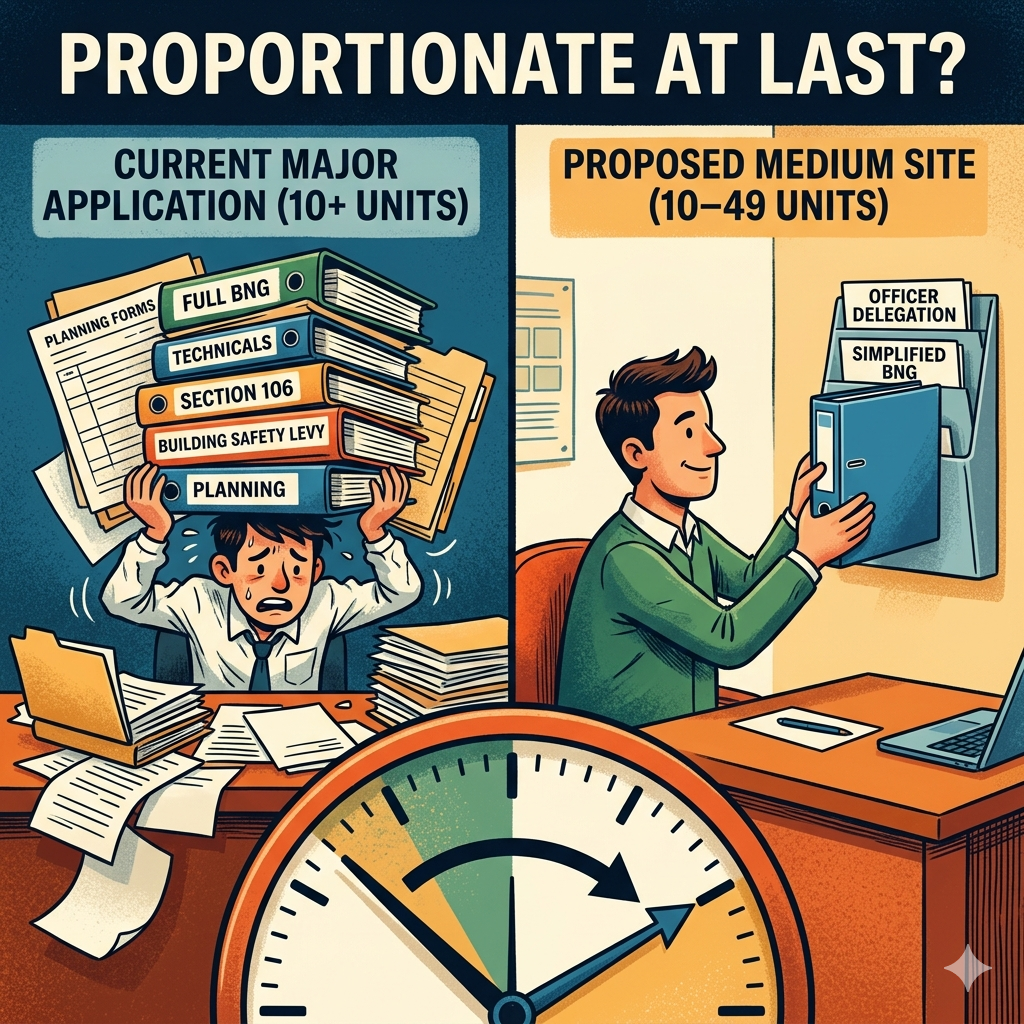
The proposed medium site threshold would cover developments of 10 to 49 residential units. Sites within this category could benefit from several specific easements compared to current major application requirements. It's important to stress that these are proposals under active consultation — not yet confirmed policy.
Simplified Biodiversity Net Gain
BNG has been one of the most significant new burdens for SME developers since it became mandatory in February 2024 (for major development) and April 2024 (for small sites). Currently, small sites already benefit from a simplified Small Sites Metric (SSM), while larger schemes must use the full Statutory Biodiversity Metric — a substantially more complex and costly process requiring detailed ecological assessment.
The government is consulting on whether a revised, proportionate metric could bridge the gap between the SSM and the full statutory metric for medium sites. The intention is to reduce the administrative and financial burden on SME developers while still delivering meaningful biodiversity outcomes — essentially avoiding the full-blown ecological assessment usually reserved for larger schemes of 50+ units.
For developers who have struggled with the cost of ecological consultants, the complexity of the full metric, and the uncertainty around on-site versus off-site provision, this would be welcome. But until the consultation concludes and final policy is published, the detail of any medium-tier metric remains uncertain.
Separately, the government has also been consulting on potential area-based BNG exemptions for smaller sites (up to 0.2 hectares) and a targeted exemption for residential brownfield development (testing ranges up to 2.5 hectares). These are consultation proposals, not enacted exemptions. If confirmed, they would work alongside the medium site category to create a more proportionate BNG regime across different scales of development.
Potential Building Safety Levy Exemption
The Building Safety Levy — designed to fund remediation of unsafe cladding on existing buildings — is expected to come into effect in Autumn 2026, subject to secondary legislation being laid before Parliament. The final scope, rates, and exemption thresholds are still being determined through consultation.
Currently, developments of fewer than 10 dwellings are proposed to be exempt. The government is exploring whether this exemption should be extended to cover medium sites (10–49 units), effectively shielding the majority of SME-scale development from the Levy. The NFB has welcomed this, noting that the government accepted their recommendation to increase the Building Safety Levy exemption threshold to 50 homes.
However, until the final regulations are sealed, this remains a proposed exemption — not a guaranteed one. SME developers should factor this into viability assessments as a potential benefit rather than a certainty.
Faster Decision-Making Through Delegated Powers
The government has proposed reforms to modernise planning committees through a National Scheme of Delegation. The intention is that smaller housing projects would be decided by expert trained planning officers rather than going to full committee — potentially reducing determination timescales and removing the unpredictability of committee dates, member call-ins, and the political dynamics that can delay straightforward applications.
This is a proposal, not current policy. Planning committees remain governed locally, and political call-ins are still common practice. If implemented, delegated decision-making for medium sites could significantly benefit SME developers — but the timeline and final form of these reforms remain to be confirmed.
Exemption from Build-Out Transparency Proposals
The government's strategy for speeding up build-out of homes includes transparency reporting requirements aimed at large sites where slow build-out is a systemic concern. Medium sites could be exempted from these proposals, recognising that build-out rates on smaller schemes are fundamentally different. This area of policy is still loosely defined and evolving.
The Area Threshold Question — The Critical Detail
This is where the proposals get complicated — and where SME developers need to pay the closest attention.
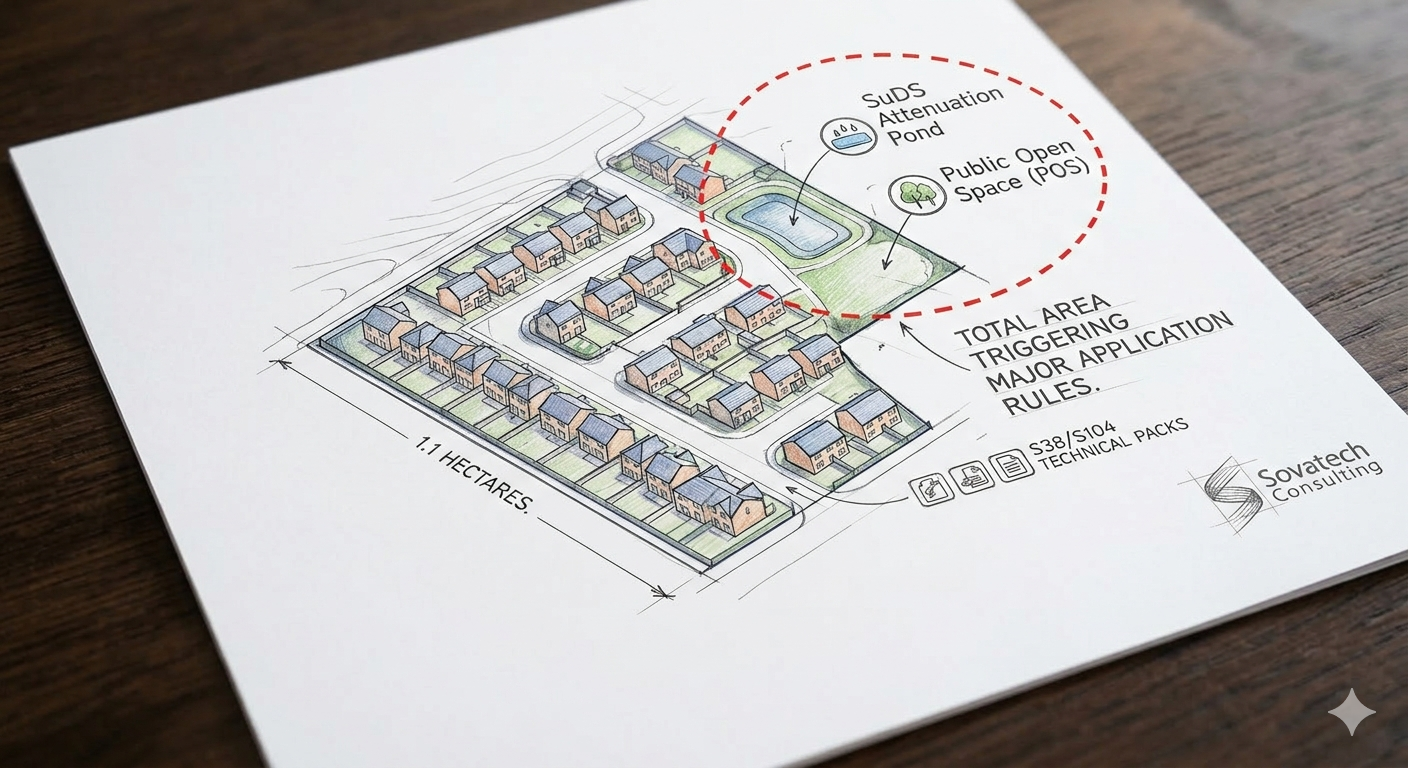
The proposed medium site category isn't defined solely by unit numbers. The government's working paper also includes a maximum area measurement of one hectare. This dual threshold — 10–49 units AND under one hectare — has generated significant concern from the SME development community.
The NFB's head of policy, Rico Wojtulewicz, has publicly stated: "We are incredibly grateful that the government has listened to industry by recognising the dwelling numbers that SMEs typically deliver on single sites. However, the inclusion of a measured area threshold risks excluding most SMEs from the proportionate planning reforms associated with a medium sized site."
The concern is practical and well-founded. A 30-unit scheme at a typical density of 30 dwellings per hectare requires exactly one hectare of net developable area — right at the proposed limit. But that's the net figure. Once you factor in roads, turning heads, open space, SuDS attenuation features, landscaping buffers, and visibility splays, the gross site area comfortably exceeds one hectare for the majority of medium-sized developments. In rural or suburban contexts where densities are lower, the disparity is even greater.
If the government maintains a rigid area cap alongside the unit threshold, there's a genuine risk that the medium site category becomes a well-intentioned reform that most SME schemes cannot actually qualify for. The government has posed specific questions in its working paper about whether solely area-based thresholds might be more appropriate, or whether unit-based and area-based thresholds should work in combination. Its response — expected later this year — will determine whether this reform delivers its intended benefits or becomes practically limited.
For SME developers currently appraising sites, this uncertainty creates a planning risk that should be factored into viability assessments. Understanding your site's gross area in relation to the proposed thresholds is now a relevant consideration at the earliest stages of appraisal.
What This Could Mean for Technical Delivery
From a technical perspective, the medium site category — if implemented — would create both opportunities and important considerations for SME developers.
Submissions May Become Proportionate — But Not Less Important
Simplified BNG requirements wouldn't mean no BNG requirements. Streamlined processes wouldn't mean reduced quality expectations. If anything, a proportionate system places a premium on getting submissions right first time, because fewer built-in review stages means less opportunity for errors to be caught before they cause delay.
This makes the quality of technical documentation more important, not less. Red line boundary plans must still be accurate and properly licensed. Location plans must still use current Ordnance Survey data. Flood risk assessments must still comply with the latest NPPF and PPG requirements. Statutory adoption agreement drawings — Section 38 (Highways Act), Section 104 (Water Industry Act), and Section 278 (off-site highway works), distinct from Section 106 planning obligations — must still meet authority-specific standards.
The difference under a proportionate system would be that the cost and complexity of preparing these submissions should better reflect the scale of the development. A 25-unit scheme shouldn't require the same volume of supporting documentation as a 250-unit strategic site — and the medium site category acknowledges that principle.
Early Technical Input Remains Critical
Nothing in the proposed reforms changes the fundamental truth that technical problems identified early cost less to resolve than those discovered mid-application or post-acquisition. Pre-purchase due diligence, site constraints analysis, and early engagement with statutory consultees remain essential — arguably more so for SME developers who have less financial resilience to absorb unexpected abnormals.
A developer who identifies drainage constraints, access limitations, or ecology sensitivities during due diligence can factor these into their land bid. A developer who discovers them after exchange is absorbing costs they didn't budget for. The medium site category doesn't change that equation.
Statutory Adoption Agreements Remain Complex
The medium site category doesn't directly address the complexity of statutory adoption agreements. A 30-unit scheme still requires Section 38 highway adoption drawings, Section 104 sewer adoption documentation, and potentially Section 278 off-site highway works agreements — each with their own technical drawing packages, authority approval processes, inspection regimes, and bond requirements.
These agreements, governed by the Highways Act 1980 and Water Industry Act 1991, are distinct from the Section 106 planning obligations that form part of the planning permission itself. They represent a separate — and often more technically demanding — process that runs in parallel with planning and construction. For many SME developers, this is where projects stall regardless of how smooth the planning process was.
Looking Ahead
The medium site category represents a genuine signal that the government recognises the disproportionate burden the planning system places on SME developers. Whether it delivers its full potential depends on the final policy detail — particularly the area threshold question — and on how local planning authorities interpret and implement the new framework.
For SME developers, the practical advice is straightforward: understand the proposals, engage with the consultation outcomes as they emerge, and ensure your technical submissions are prepared to the highest standard regardless of which threshold category your site falls into. Proportionate regulation would be a significant step forward, but it is not a substitute for technical precision. Even within a streamlined system, the quality of your initial submission is what prevents the "planning creep" that erodes SME margins.
The Housing Minister has described the broader package of planning reforms as representing "the most significant reform to national planning policy since the original NPPF was introduced more than a decade ago." For SME developers who have spent years navigating a system designed primarily for major housebuilders, that ambition — if matched by proportionate implementation — could genuinely shift the landscape.
If you're an SME developer appraising or delivering sites in the 10–49 unit range and need technical support — from pre-acquisition due diligence through to planning submissions, BNG compliance, and statutory adoption agreement coordination — Sovatech Consulting can help. We provide Head of Technical-level expertise without the full-time overhead, ensuring your submissions are right first time as the regulatory landscape continues to evolve. Contact us to discuss your next project.
